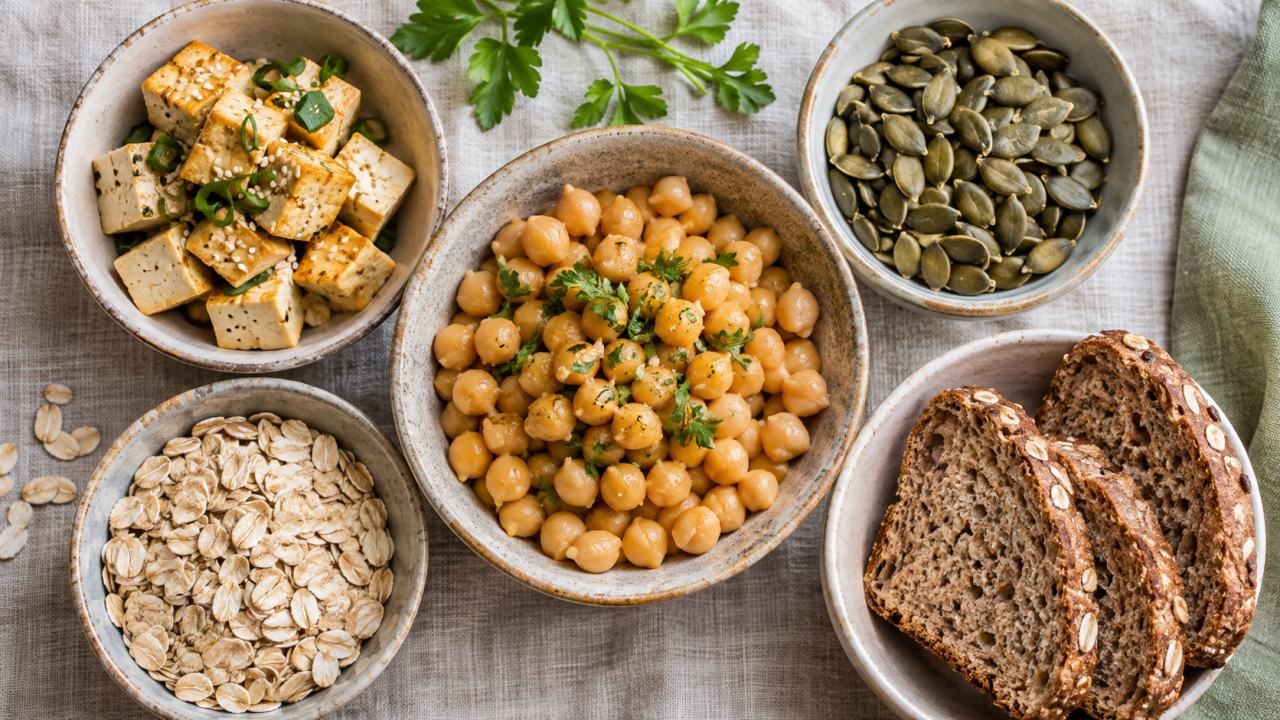
Beans, lentils, seeds, nuts and whole grains can contribute zinc to a plant-based diet. Check the foods and amounts you actually eat, distinguish zinc content from absorption, and get individual advice before using supplements to address a suspected deficiency.
Start with the question you need answered
Zinc is an essential mineral involved in normal growth and several functions of the body. The NIH Office of Dietary Supplements explains its sources, assessment and the limits of interpreting zinc measurements. A practical food question might be whether your weekly menu includes suitable sources. A clinical question might concern symptoms, a condition or a test. These require different evidence. Name the question before looking for a product or number.
For meal planning, begin with a few ordinary days. Record which pulses, grains, nuts, seeds and soy foods you eat, including approximate amounts. Include foods eaten outside the home and any fortified products. A cupboard inventory cannot show what gets eaten. If a bag of seeds is rarely used, it contributes less to the actual routine than a food that appears regularly.
For a clinical concern, speak to a qualified clinician. Symptoms can have more than one cause, and a single blood result has limitations. Bring relevant medicines and supplement labels to the conversation. This guide provides educational context and practical food examples. It cannot determine whether an individual is deficient or prescribe an amount to take.
Find sources in everyday meals
The NIH fact sheet identifies beans, nuts and whole grains among plant sources and gives examples including cooked lentils, oats and pumpkin seeds. Treat those examples as foods to investigate in your own portions. Food composition varies with preparation and product. The quantities in a reference table should be read with the stated serving and unit.
Look at dishes you already know. Lentil soup, a chickpea sandwich filling, a bean stew, porridge or bread can contribute different amounts. You might use seeds as a topping or nuts as part of a snack. Consider their role in the meal as well as their mineral content. These suggestions illustrate a planning process, not a menu guaranteed to meet an individual’s needs.
If you replace one source, identify what will take its place. For example, stopping a regular breakfast does not mean another product automatically provides the same nutrients. Compare what you will actually eat at that time. Keep your alternatives realistic for access, budget and preparation. A food that is difficult to buy is unlikely to become dependable just because it appears on a source list.
Read amounts without confusing dry and prepared foods
Check whether a table describes dry, cooked, drained or otherwise prepared food. Dry pulses take up water during cooking. A reference amount for dry food cannot simply be applied to the weight of a cooked serving. Match the form as closely as possible. If your database entry refers to cooked lentils and you weigh cooked lentils, the comparison is easier to explain.
A label might give a nutrient per 100 grams or per serving. Suppose a hypothetical product listed 2 milligrams per 100 grams and you ate 150 grams. The arithmetic gives 3 milligrams for that portion. These are example figures, not typical values or a recommended intake. Keep units visible and do not combine a reference percentage from one label with an amount from another as though they were the same.
Absence from the label does not necessarily mean a food contains no zinc. Mandatory label entries vary by market. Use an appropriate food composition database for a general ingredient or current manufacturer information for a particular product. Record the source of the number. When information is unavailable, leave it unknown rather than borrowing a value from a different formula.
Understand why absorption is a separate issue
The NIH fact sheet explains that phytates present in some plant foods can bind zinc and reduce its absorption. The amount listed in food and the amount absorbed are therefore different quantities. This helps explain why planning guidance considers both the food pattern and bioavailability. It does not turn a useful food into something to eliminate automatically.
Preparation methods can affect phytate, and guidance may discuss soaking, fermentation or other processing. Use established methods appropriate to the ingredient and its safety requirements. Do not improvise a raw-bean or sprouting procedure because it is described as improving a nutrient. Ordinary cooking instructions and safe food handling remain part of preparing food.
Avoid assigning yourself a precise absorption percentage from a short meal record. Absorption depends on more than the presence of a seed or grain, and individual circumstances matter. A qualified dietitian can help interpret a pattern when there is a specific need. For an ordinary shopping decision, identifying suitable foods and using accurate portions is a sensible first step.
Compare one day’s meals without scoring them
Imagine breakfast includes oats, lunch includes chickpeas and dinner uses lentils. List each food and its prepared amount. Then check a reliable source for that form if you need a numerical estimate. Mark any food whose amount or composition is unclear. The exercise reveals where your information is missing without presenting the result as a diagnosis.
Now compare that day with a busy day when lunch is skipped and dinner is bread with vegetables. The difference is about the pattern actually eaten. A useful adjustment may be a practical pulse-based lunch or a dependable snack, rather than increasing an obscure ingredient. Choose something that fits the schedule and the broader diet.
Review more than one day if the pattern varies. A weekend with time to cook may not represent workdays. A record that includes the difficult days is more helpful for planning. If you share the record with a professional, say whether the quantities were measured or estimated. Keep the original label where it answers a product-specific question.
Use fortified foods according to their labels
Some foods are fortified with zinc. Read the name of the nutrient and the amount for the stated serving. A product fortified with calcium or vitamin B12 is not necessarily fortified with zinc. The front panel may emphasize only one nutrient. Check the nutrition information and ingredients for the exact item you are considering.
If you use a fortified cereal, record the dry portion and any drink added separately. Two sources can make separate contributions. A product sold in another country or under a similar name may have a different formulation. Use the package available where you live. Recheck when the recipe, packaging or serving changes.
Fortification can be one part of a food pattern. It does not establish that every nutritional question is resolved. Consider the other foods in the meal and the reason for using the product. If the choice is meant to address an individual requirement or a suspected problem, ask a qualified professional how it fits that situation.
Ask the right questions about supplements
Bring the exact supplement label to a pharmacist, clinician or dietitian if you are considering one. Ask whether it is appropriate, how it relates to other products already used and whether medicines affect the decision. The NIH fact sheet discusses excessive intake and interactions. More zinc is not an automatic improvement over an adequate intake.
Cold products or multivitamins can contain zinc even when that is not the main reason they are used. Include them when discussing your routine. Read the amount per tablet or dose and the directions. A compound name on the package and the elemental zinc amount on a supplement table may describe different quantities. Ask when unsure.
Do not use this guide to change prescribed treatment or interpret a child’s needs. Pregnancy, breastfeeding, restricted eating and conditions affecting absorption can require individualized planning. A professional may need information beyond a shopping list. A clear record makes the conversation easier without claiming that you can diagnose yourself from it.
Further practical examples
At a grocery shop, compare a food you regularly finish with a large bag promoted as nutrient rich. Ask what portion you realistically eat and how often. If most of the second product remains unused, its theoretical contribution does little for your actual routine. Choose the form that works and record its preparation state when you look up composition.
In a small kitchen, ready-to-use pulses may be easier than a large dry batch. Drain or prepare them according to the product and your recipe. Check any added ingredients, especially when allergies or restrictions apply. Cost per usable portion and access can influence whether the choice becomes repeatable. You can consider those factors without pretending to calculate nutrient absorption.
For a packed lunch, select food that can be transported and stored safely. A meal that must be chilled needs an appropriate cold chain. If facilities are absent, identify an alternative that is suitable unopened and prepare it at the point of eating if needed. A zinc-related goal does not remove the practical requirements of keeping food safe.
For a repeated purchase, keep a photo of the current label if it supplies useful information. Note the portion, market and date. Revisit the record when the product changes. This prevents an old formulation from becoming a permanent assumption about a brand. It also helps a dietitian see what a calculation was based on.
If you cannot find a nutrient line, use a reliable database entry for a closely matching general ingredient and label the estimate as such. Do not call it a measured value for the brand. A precise-looking total built from mismatched entries can be less useful than a clear account of the foods and uncertainty.
When a meal record raises several questions, decide which needs answering first. A food access problem may be addressed with a simpler menu. A question about a supplement and medicines belongs with a pharmacist or clinician. A possible deficiency requires individual assessment. The same notes can support these conversations while keeping their purposes clear.
Additional checks for a useful food record
Begin with the foods that recur most frequently. A breakfast with oats, a lunch using beans and a dinner with tofu describe different opportunities to investigate zinc. Write the amount and preparation state for each. If you do not know the amount, note that it is estimated. The purpose of this record is to make a question answerable. It is not evidence that a person is deficient or that any one of the foods supplies a fixed share of an individual’s requirement.
Take one product label and identify the unit before reading the number. Milligrams, micrograms and a reference percentage are different forms of information. Keep the original unit with the amount and state which serving it describes. If a label gives only a percentage, find the reference used in that market before attempting a conversion. If you cannot establish it, save the label and ask. A transparent unknown is more useful than a calculation with a hidden assumption.
Use a reliable database carefully for ingredients that have no zinc line on the pack. Match cooked with cooked and dry with dry. If your meal contains drained beans, look for an entry whose preparation resembles that form. A database estimate for a general ingredient remains an estimate for your portion. Do not label it as a laboratory measurement of the brand. Recording the database item name helps another person identify how the estimate was made.
If the aim is to discuss nutrition with a professional, include what happens on days when routine breaks down. A food diary that shows only carefully planned days may miss skipped meals or limited access. Describe the lunch eaten at work and what replaces it when the cafeteria is closed. That context can make practical advice more useful. A clinician or dietitian can then decide whether more detail is needed and which information is relevant to the individual question.
Keep supplement records in a separate part of the note. List the product, amount per unit and actual directions followed. Include multivitamins, lozenges and other products that may contain zinc, even if purchased for another reason. Bring them to a pharmacist or clinician when asking about suitability or interactions. An answer about one product cannot automatically be applied to a different dose or combination. This article provides no personal schedule for taking supplements.
A meal comparison should not become a reason to remove whole food groups without suitable advice. A source may explain a factor that changes absorption, while the food containing that factor still contributes other nutrients and fits the diet. Ask what the complete food pattern looks like and what the professional recommendation actually says. Keep the difference between a laboratory mechanism, a population guideline and an individual’s situation clear when interpreting an online claim.
Try a small practical adjustment if the issue is access to a suitable meal. A ready-to-use pulse can make lunch possible on a day without cooking facilities. A smaller package may be easier to finish than a large batch. A familiar dish may be repeated more consistently than an unfamiliar food chosen only because it appears in a nutrient list. Note which solution you can sustain. The objective is an actual routine, not a longer list of theoretical foods.
Summary
Identify zinc-containing foods in your actual routine, use compatible portions and preparation forms, and distinguish food content from absorption. Fortified foods and supplements need product-specific checks. Seek individual advice for symptoms, suspected deficiency, life-stage needs or interactions.
Frequently asked questions
Do plant foods contain zinc?
Yes. Pulses, nuts, seeds and whole grains can contribute zinc, with amounts varying by food and portion.
Does a food’s listed zinc amount equal what I absorb?
No. Absorption is a separate issue affected by the diet and individual circumstances. Do not treat a label as a personal absorption measurement.
Should I stop eating foods that contain phytate?
Phytate is one consideration in the wider pattern. Those foods can still contribute nutrients. Discuss personal concerns with a qualified professional.
Can I choose a supplement dose from this article?
This article does not provide a personal dose. Bring the exact product, other supplements and medicines to a pharmacist or clinician.
Leave a Reply