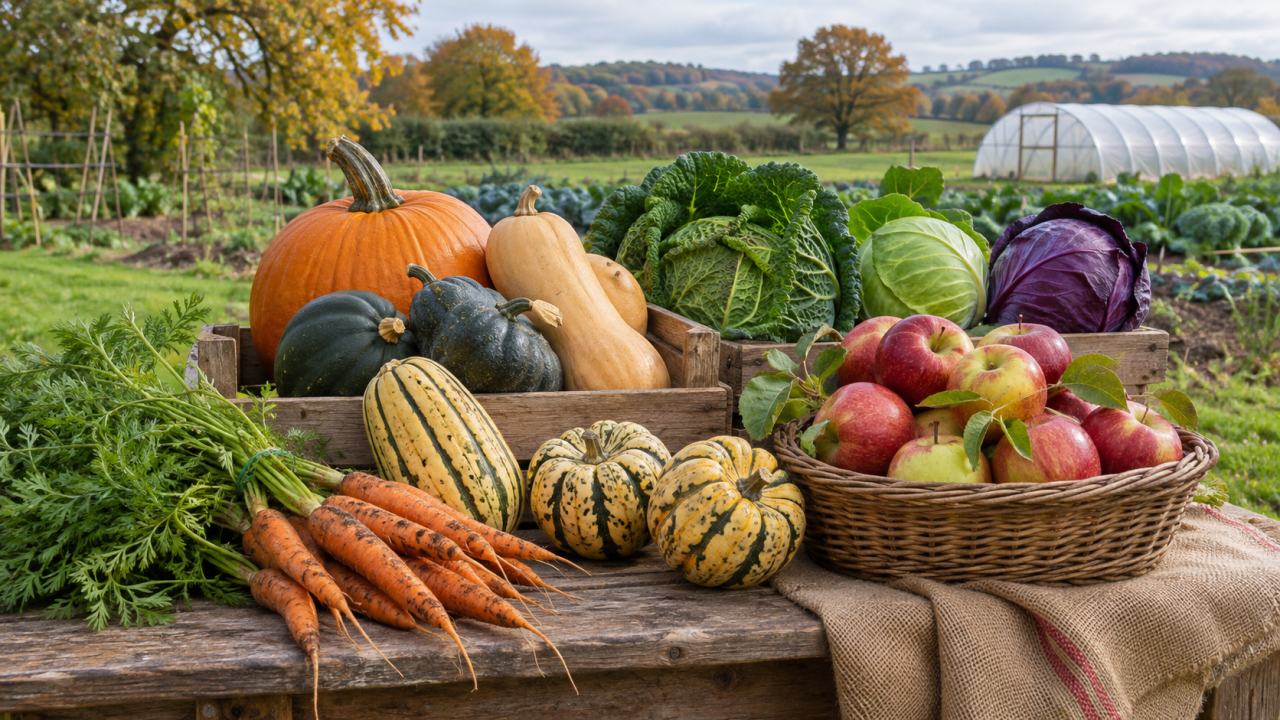
A food being in season can tell you something about harvest and availability. To assess environmental impact, also ask where and how it was produced, how it was stored and moved, and what quantity will be eaten. Define the comparison before drawing a conclusion.
Specify what seasonal means
A product may be harvested in the local open-field season, grown under cover nearby or imported from a region with a different climate. All can appear in a shop during the same month. The word seasonal needs a place and production context. Write the food, region and time of year in the first line of the comparison.
Distinguish harvest from sale. A crop may be harvested earlier and stored, or harvested elsewhere shortly before delivery. The date on a market display does not show every stage. Ask what the seller can confirm and leave other details unknown. A local company’s address may identify the business rather than the field.
Personal preference and environmental evidence can coexist without being identical. You may prefer the taste of a harvest or want to support a familiar grower. Those are reasons for a purchase. A claim about lower greenhouse gas emissions or water impact requires evidence for that measure. State which question you are answering.
Compare like quantities and the same indicator
Choose an environmental indicator, such as climate impact, and a common amount of usable food. A kilogram harvested, a kilogram sold and a kilogram eaten can differ because of trimming or loss. If you compare fresh and frozen versions, account for the preparation state before treating weights as equivalent.
A meal comparison needs the ingredient amounts actually used. A number per kilogram of an ingredient is a starting point, not a result for a plate. Convert only where the reference and recipe quantities are compatible. If a conversion is uncertain, document it rather than presenting an exact total.
Avoid collapsing all environmental effects into one unstated meaning of better. Climate impact, land use and water-related outcomes are different indicators. A study can report several. Read which ones support its conclusion and whether the comparison changes across them. A single headline may omit those qualifications.
Check production conditions before distance
Open-field cultivation and protected cultivation can involve different inputs. Heating, lighting, yields and the source of energy can matter in a greenhouse scenario. Ask which conditions the estimate represents. A product called local can come from a heated system, while a more distant crop may grow in a different climate.
A 2022 comparative life-cycle study of tomato supply analyzed eight scenarios and found that its results depended on agronomic management and transport efficiency. In that study, proximity alone did not identify the preferable scenario. This supports checking the modeled conditions. It does not give a universal ranking for every tomato or season.
For another product, look for evidence about that product’s production. A result for tomatoes cannot simply be assigned to apples, leafy greens or grains. Production methods, storage patterns and use differ. A specific example can explain the method without claiming to measure an unrelated food.
Follow transport as a process
Distance is one variable. Transport mode, loading and refrigeration can affect the estimate. A long efficient route and a short separate journey are not described fully by kilometres. Read which stages the study includes and what assumptions it makes about movement.
A shopping trip may also matter to the scope. If you drive separately for a small amount of produce, a study ending at retail may omit that trip. Do not add a guessed transport number to an already complete estimate. Identify whether the stage is included before changing the total.
A market seller may know the origin but not the full distribution route. Record the information available and ask a precise question about the missing part. Uncertainty is useful to show. It prevents an origin label from becoming a detailed footprint claim without supporting data.
Consider storage and the amount used
Storage can extend access to a crop beyond harvest. Temperature control, duration and losses can affect a life-cycle estimate. Check whether the source includes them. An older stored crop and a freshly harvested imported crop require a comparison of actual systems rather than an assumption based on either description.
Frozen or canned food may fit a household because it can be used in smaller amounts. Fresh food may work well when it is eaten promptly. Compare the portion that reaches the plate and what happens to the rest. A theoretical advantage at the farm can be affected by repeated household waste, depending on the full comparison.
Do not assign an environmental number to waste without data. You can record that one purchase leaves more unused food and use that observation for a practical decision. Estimating the complete impact requires compatible data for production, handling and disposal. Keep your observation distinct from the modeled footprint.
Read the study boundary and reference conditions
Find where the calculation starts and ends. A farm-gate estimate, a retail estimate and a full household consumption estimate cover different stages. Match the boundary before comparing numbers from two sources. A newer publication may also use data from an earlier year.
Look at the geographical setting and energy assumptions. A heating estimate from one region may not describe a greenhouse elsewhere. A crop yield can vary, changing an impact expressed per amount of product. If the authors provide scenarios or uncertainty ranges, read those alongside the average.
When a source combines indicators into a score, find the weighting or aggregation method. A single score can conceal which impact drives the result. If your question concerns water in a scarce region, a climate-only ranking cannot answer it. Choose evidence that matches the decision you want to make.
Work through a market comparison without inventing a result
Imagine choosing between nearby autumn tomatoes and imported tomatoes. Write down the actual products and how much you will use. Ask where each was grown, whether the production system involved heating and what route is known. The season alone does not provide those answers.
Now identify a source with compatible scenarios. Check product, region, method, unit and stages. If the source does not match the options, describe what it can still tell you and where it stops. You may learn that heating is a relevant question without knowing its actual contribution for either product.
A useful outcome can be a narrower conclusion. You may choose a product for taste or freshness while acknowledging that a complete footprint comparison is unavailable. You can also decide to use a different available vegetable. Describe why you chose it without presenting the choice as a measured environmental result.
Make a seasonal plan that fits the kitchen
List a few available vegetables you know how to use and where they fit into meals. A harvest basket is useful only if the household can eat or store the contents appropriately. Choose quantities based on the next meals and safe storage. Variety in the shop does not require buying everything.
If a recipe calls for a vegetable unavailable locally, ask what function it serves. A firm vegetable in a roast may be adapted differently from a delicate salad component. Changing the dish can be easier than forcing a substitute into the same method. Record which result worked for your cooking.
Review what was eaten after a week. Did the produce fit the time and equipment available? Which item spoiled or required an extra trip? Those observations support a practical seasonal routine. They are not a substitute for life-cycle data, but they can make the food you buy more likely to be used.
Further practical examples
For a restaurant menu, ask whether the seasonal claim describes ingredients, a changing selection or sourcing policy. An establishment can use the phrase for different reasons. A statement about local harvest needs origin information. An environmental claim needs further evidence. Request the part relevant to your decision.
For a household comparing fresh and frozen vegetables, use the amount actually eaten. Note whether the frozen product is trimmed and whether the fresh version leaves substantial waste. Use safe handling and storage for both. Price, convenience and preference can be discussed even when no footprint calculation is available.
For an article or social post, keep the study’s unit and context next to any numerical result. Name the food and scenario instead of saying that seasonal food always has one outcome. Link the original research and describe the limitation that matters. The reader should be able to see what the evidence actually compared.
For a producer’s claim, distinguish a statement about method from a measured impact. Saying a crop is grown without heating establishes a feature if verified. It does not measure every input or outcome. Ask which study or record supports a broader claim and which stages it covers.
For two regions with different growing seasons, describe each period explicitly. A calendar built for one climate may be a poor guide elsewhere. Local agricultural or market information can establish harvest timing, while environmental assessment remains a separate inquiry. Avoid presenting a language edition as if all its readers lived in the same growing region.
For a repeat purchase, record the product and the one missing detail you would most like to know. A precise question about heating or storage may be more answerable than asking a seller for an entire footprint. Update the record when conditions change. A seasonal comparison should remain tied to real products and dates.
Additional checks for interpreting seasonal claims
Choose a product and a purchase occasion before looking for a general seasonal ranking. Tomatoes bought for a fresh salad and vegetables intended for a cooked stew can involve different alternatives. Record the amount you will actually use and the stage at which the product is sold. A whole fresh item and a trimmed frozen portion may not represent the same edible quantity. Without that distinction, a comparison can look exact while answering a different question.
Ask what the seller means by seasonal. It may describe current harvest in a named region, a marketing selection or food that is customary at that time. The answer can help you assess freshness or plan meals, but it does not measure the whole environmental footprint. If the environmental question matters, ask a more specific question about production or storage. A seller may be able to confirm heating conditions or origin even when no full life-cycle study is available.
Look at whether the evidence uses a measured product, a modeled scenario or a broad average. Each can be informative within its scope. A scenario may show how a greenhouse heating assumption affects the result without establishing the exact impact of the item in your shopping basket. A broad average can provide context while hiding variation. Keep the source’s description beside the conclusion so a reader can see how closely it matches the decision.
If the comparison spans two regions, describe both climates and production systems only to the extent supported by evidence. Do not infer heating, water scarcity or transport mode from distance alone. A nearby grower may use an unheated system or a heated one. A distant product may use different routes. The point is to ask what applies, not to replace one generalization with another. Leave the unknown detail visible if the available information cannot resolve it.
Storage is another stage that can change with season. Ask whether a crop was kept chilled after an earlier harvest and whether the study includes that period. A product sold outside harvest time may have several possible histories. If you compare it with a current imported harvest, align the boundary before drawing a result. If the sources omit different stages, present them as partial descriptions rather than adding incompatible figures into a single total.
A practical household plan can still improve when environmental data are incomplete. Choose produce you know how to use, buy an amount that fits the next meals and store it appropriately. Note which item repeatedly goes uneaten. This records a behavior you can change without claiming a numerical footprint. If a recipe needs a vegetable unavailable in the local season, consider another dish whose method naturally fits what is available.
Use a small worksheet for a recurring decision. Record the product, region, season, edible amount, known production conditions and the relevant study or supplier answer. Add the environmental indicator you are comparing. A claim about greenhouse gas emissions needs a different measure from a claim about local water pressure. If you only have evidence for one, state that narrower finding instead of extending it to all impacts.
If someone shares a chart without its notes, locate the original source before quoting the result. A cropped image can omit the unit, year, scope and uncertainty. Check whether a recent article is repeating older data and which conditions the original authors assumed. When a study reports several scenarios, explain which one the chart selected. A precise number without that context can communicate more certainty than the study supports.
When communicating your own choice, name its practical reason. You may prefer a ripe product from a familiar seller, a smaller pack that will be finished or a frozen option that fits an uncertain week. These are legitimate features to discuss. They become an environmental claim only when linked to appropriate evidence. Keeping the reasons explicit makes the account more useful to someone whose facilities, budget or local harvest differs.
Summary
Define the region, season, production method, amount and environmental indicator. Read transport and storage within the same boundary. Use research for the scenarios it actually studied and keep practical shopping reasons visible when a complete comparison is unavailable.
Frequently asked questions
Is seasonal food always lower in environmental impact?
The outcome depends on production, storage, transport, waste and the indicator. A seasonal label alone cannot determine it.
Does local origin settle the comparison?
No. Ask about the production system and the stages included in the evidence.
Can a tomato study rank every vegetable?
No. Its findings describe its products and scenarios. Other foods need relevant evidence.
What can I do when full footprint data are unavailable?
Record what is known, avoid invented totals and choose using the practical criteria you can verify.
Leave a Reply