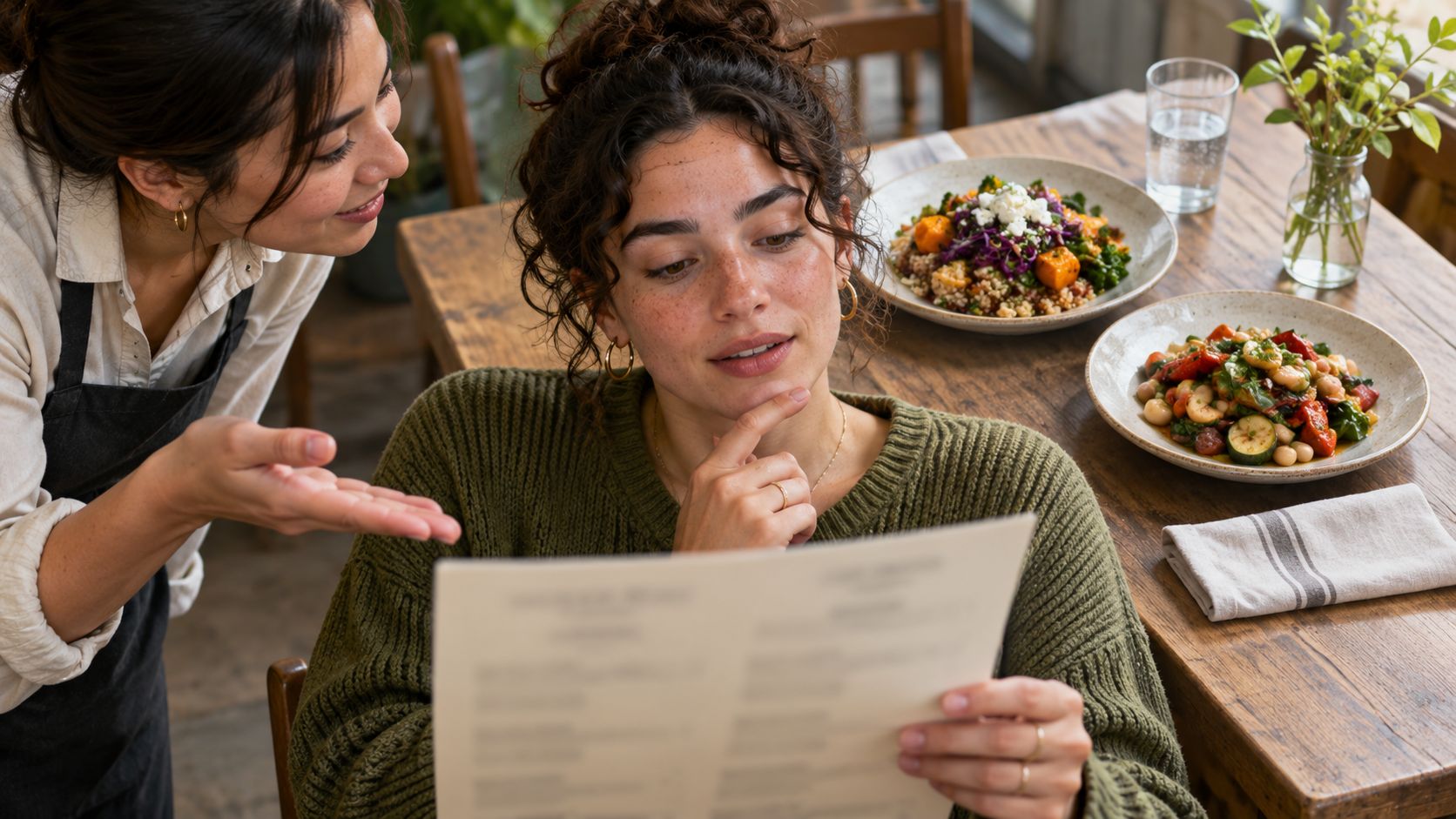
On the menu, a vegetarian dish may contain eggs or dairy, and a vegan dish is made without animal ingredients. To identify, just look at the title and photo for possible options. Then ask about the base, sauce, cooking method, and final toppings. Cheese is usually on the dish, but broth in the soup or butter added to the rice before serving may not be on the menu. [1] [2]
What can you tell from the title and the sign next to the food?
If the menu uses symbols like a leaf, V, or VG, read the menu description itself. Restaurants may use different symbols. When there is no sign guide, ask what the symbol means in the same set. The sign may refer to a ready-made version or simply say that the dish can be changed at your request. On the second order, you should clearly state the change and make sure it is recorded on the invoice or order.
Phrases like “vegetable,” “vegetarian,” “meatless,” or “vegetarian-friendly” alone don’t define all the ingredients. A vegetable pasta dish might have a creamy sauce, a salad might be served with an egg-based dressing, and a rice dish might be prepared with butter or stock. If the menu only lists a few prominent ingredients, consider that list an introduction to the taste and appearance of the dish. Refer to the full recipe or someone who knows the kitchen for the final decision.
If you see a picture of a dish on an online menu, match the name and recipe to the current menu. The photo may be old, a sample of the dish, or from another branch. When ordering over the phone, first state the name of the dish and the branch. If you see the words “can be ordered vegan,” ask about specific changes. For example, specify that the cheese will be removed or the sauce and base will be changed. This is more helpful than a general confirmation of the food choice.
Check the base, sauce, and topping separately.
In soups and stews, start with the cooking liquid. Ask, “Is this food cooked with water, vegetable stock, or meat stock?” If the answer is that it doesn’t contain any meat, ask again about the liquid. In pre-prepared dishes, removing the pieces at the time of serving does not change the composition of the liquid. If the base is cooked with animal ingredients, look for a dish that is prepared from scratch with the appropriate base.
For sauces, ask about the main ingredients and the prepared mixture. For a white sauce, milk, cream, or butter may be important. For a salad dressing, eggs, dairy, or honey may be involved. In some dishes, the sauce is served separately and can be left out. If the sauce is mixed with the food from the start, the possibility of changing it depends on the restaurant’s preparation method. The sauce on the side of the plate may not be the only sauce used with the dish, so link the question to the cooking method.
Don’t forget about the toppings and final garnishes. Grated cheese, *kashk* (fermented whey/yogurt product), melted butter, and sauces can often be added after the main dish is prepared. If you would prefer these to be left off, be sure to mention this when placing your order. If you are ordering for someone whose preferences you don’t know exactly, do not make assumptions regarding dairy or eggs; the requirements for vegetarian and vegan diets can differ significantly in this regard. [1] [2]
What questions are useful to ask when dealing with familiar menus?
When ordering from an Iranian menu, ask whether butter or meat stock is added to the rice during cooking or at the time of serving. For *ash* (a thick Persian soup/stew), inquire about the *kashk*, the stock used, and the type of noodles (*reshteh*) included. For eggplant-based dishes, ask about the sauce and any toppings. If you are ordering a dish that includes bread, consider the bread, the main filling/toppings, and the sauce as three separate components; it is possible that only one of these requires clarification. In a busy environment, a short, specific question is usually easier to communicate effectively to the kitchen staff.
When ordering pasta, start by clarifying the sauce, then ask about eggs in the pasta dough or cheese added as a garnish. For a vegetable pizza, removing the cheese is just one step; if the dough or sauce is prepared in advance, ask about those as well. For dishes served with a sauce or dressing, specifically ask about the ingredients—for example, “Does the sauce for this dish contain any fish or meat-based ingredients?” This helps the staff provide a more precise answer than simply repeating what is written on the menu.
For breakfast or snacks, the base ingredients of a dish are not always obvious from its name. If a dish is prepared with vegetables and eggs, it may be suitable for some vegetarians, but vegans will need to look for other options. If you are ordering a plant-based drink or dessert, do not assume that the presence of “oat” or “soy” implies that all other ingredients (additives, toppings, or sauces) are also plant-based. When in doubt, ask about the type of milk, topping, or sauce used. These examples are intended to illustrate how to ask questions; they do not make claims about the menu of any specific restaurant.
State your request clearly in a single sentence.
When placing your order, you might say: “I would like this dish prepared without meat, fish, eggs, or dairy. Are the base and the sauce also free from these ingredients?” If other items—such as honey—are a concern for you, mention them specifically. If you are a vegetarian who consumes dairy, clarify this so that your request does not become unnecessarily complicated. If the staff members do not know the answer, ask if they can check with the kitchen. It is best not to pressure someone to provide a definitive answer about something they have not personally verified.
When ordering for a group, specify any modifications for each dish individually. Saying “Pasta for the first person, without cheese or dairy-based sauce” is much clearer than simply saying “make one of them vegetarian.” After placing the order, repeat the name of the dish along with the requested modifications. If several dishes look similar, ask the restaurant to mark the containers. When the food arrives, check for these markings to ensure that any mix-up in distribution is not mistakenly attributed to an error in preparation.
If the answer remains unclear, opt for a simpler choice. A dish with clearly identifiable ingredients, a sauce served on the side, or one prepared from scratch is less likely to raise questions. If no existing option meets your needs, you might ask about combining two simple components. Before heading to a party or restaurant, having a backup option in mind prevents you from having to make a hasty decision based on incomplete information. Regarding your plan for the first few weeks, A Vegetarian/Vegan Starter Checklist for the First Week also covers this scenario.
Distinguish between food allergies and dietary preferences.
If someone has an allergy, explicitly name the allergen; do not rely solely on a “vegan” or “vegetarian” label on the menu. A dish might be prepared without intentionally adding dairy, yet still be processed in a shared environment or using shared equipment. Inquire about cross-contact and preparation methods. Official UK guidelines differentiate between “vegan” claims and allergen information—a distinction worth noting. In the context of menus in Iran, you should base your decisions on information provided by the specific establishment, tailored to the individual’s needs. [3] [4]
For instance, if there is a milk allergy, ask whether butter, cheese, or milk-based ingredients are included, and whether the cookware, preparation surfaces, or utensils are shared. If the response is simply, “We’ll just leave out the cheese,” this does not address the possibility of cross-contact or the presence of other ingredients. If a restaurant cannot provide a clear assurance regarding the prevention of cross-contact, do not assume that an item with an “unknown” status is safe. In cases involving food allergies, base your decision on medical advice and specific, factual information about that particular establishment.
While concerns regarding dietary ethics (such as vegetarianism) and food allergies may arise at the same table, they carry different levels of priority. If you are placing an order for multiple people, communicate allergy-related information separately and clearly. Note the specific allergen and the corresponding request next to each dish. When the food arrives, verify which dish belongs to which person. Separating this step from the interpretation of menu labels helps reduce the risk of misunderstanding.
Review the three orders before making payment.
In the first scenario, a vegetable soup appears on the menu, and the staff confirm it contains no meat chunks. Ask what the cooking liquid (broth/stock) is made of, and whether cream is added to the soup during the cooking process or served separately. If the kitchen indicates that the soup base is prepared using chicken stock, you should choose a different dish with a clearly defined base. If the cream is merely a garnish and the other ingredients are confirmed to be safe, you can request that the garnish be omitted when placing your order. The decision-making process is guided by the point at which an ingredient is introduced into the recipe.
In the second scenario, the menu includes a vegetable pizza and plain bread. While the staff may be able to provide clear information regarding the cheese, they might be unsure about the dough. If the kitchen has access to the dough’s ingredient label or recipe, specifically ask whether it contains milk or eggs. If the type of dough varies, opt for a dish with a known, consistent composition. When ordering for a group, clearly identify the modified pizza—by name or number—so that it can be easily distinguished if several similar-looking boxes arrive.
In the third scenario, you have ordered a specific dish from a restaurant multiple times, but the menu description has since changed. Inquire specifically about the altered component. For instance, if a house-made sauce has been replaced by a pre-made, store-bought version, do not assume that previous information still applies to this new product. If the composition remains unchanged, keep a brief note for future orders—for example: “As long as the sauce and base remain the same, only verify the garnish before ordering.” Note that such a note does not replace the need to obtain fresh confirmation regarding food allergies or sensitivities.
Summary
Consult the menu key provided by the restaurant and ask about the base, sauce, cooking method, and toppings. Associate any requested modifications with the specific dish, and verify them upon delivery. If food allergies are a concern, consider allergens and the risk of cross-contact separately from vegetarian or vegan dietary choices.
Frequently asked questions
Is meat-free food always vegan?
To determine, you need to check the composition of the food. The absence of meat in the name or appearance of the food does not provide sufficient information about the presence of dairy, eggs, honey, or extracts. Start the question with the base and sauce of the food. [1] [2]
If they remove the cheese from the food, will it be considered vegan?
It depends on how the other ingredients are prepared. Ask about the dough, sauce, butter, and base before ordering. If the cheese is mixed with the ingredients before preparation, removing the topping will not change the composition of the base.
Is the vegan label enough for milk allergy?
Be explicit about allergies and ask about the presence of the ingredient and the possibility of cross-contamination. The vegan label alone does not guarantee suitability for people with allergies. [3] [4]
If the order is online, where do I enter the explanation?
Write the change in the description of the same dish and if the composition or sensitivity is important, contact the same branch before paying. Do not leave a description of a dish in a general section that may apply to all dishes.
Leave a Reply