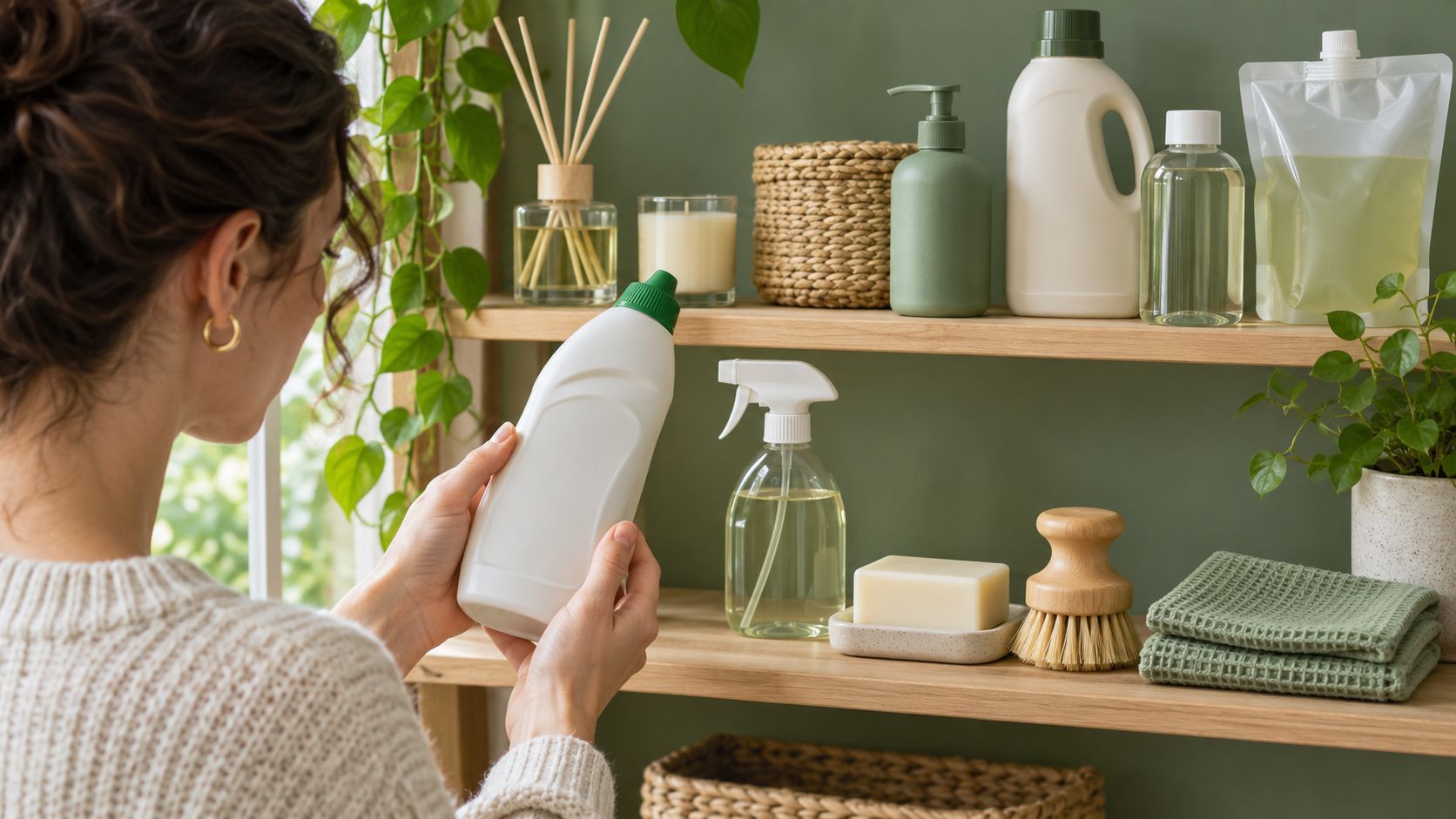
If you want to align your home with vegan choices, start with the product you’ll need to buy again soon. Write down the exact name, check the ingredients and components, and ask the manufacturer if you don’t have enough information. Along with this list, keep a separate record of your existing durable items. It’s not the same time to buy toothpaste again as it is to change your blanket. Dividing the work by purchase time helps you find information first for decisions that are really close.
Create a simple list with clear statuses
Write down three characteristics for each item. First, the exact name and type, second, the approximate time of the next purchase, and third, any information you have about the ingredients or label. The general phrase “detergent” won’t help much with your next purchase. If you write down the full product name, scent, or size, you can link the manufacturer’s response to the same copy. For clothing, labels and photos of components such as linings or straps are also useful.
Choose four practical situations. “Information confirmed,” “Ingredients known but process information incomplete,” “Composition unclear,” and “No need to buy now” are good examples. Write the situation according to what you know. The manufacturer may have stated the material of the upper of a shoe but not given a clear answer about the lining. In that case, record only that specific part in the definitive note.
The British Vegan Society’s definition emphasizes avoiding the exploitation and cruelty of animals as much as possible and practical, and its scope includes food, clothing and other uses. For the home, you can translate this definition into actionable decisions. Prioritize recurring consumption choices, identify ambiguities to follow up on, and write down the real limitations of your decision when you don’t have an available alternative. [1]
Check the kitchen and bathroom with repeat purchases.
In the kitchen, look at the dishwashing liquid, the cleaner, and the sponge or brush separately. For detergent, specify whether your question is about the origin of an ingredient, the product’s composition, or the product’s testing policy. For brushes or sponges, the type of fiber or the glued part may be important. A specific question usually gets a more practical answer than a general request, “Is the entire brand vegan?” Send a photo of the back of the package and the exact name of the product when contacting.
In the bathroom, start with items that will run out in a few weeks. For toothpaste, soap, shampoo, or lotion, record the exact name and version. Two scents from the same line may have different ingredients. If you see a description of a model in an online store, make sure the image you’re looking at is of the same model. If the information on the package differs from the sales page, ask the manufacturer about the current version and market release.
If you use a specific product for sensitive skin or other particular needs, ensure that any change aligns with those requirements. Plan the transition to an alternative well before your current product runs out, so you aren’t forced to make a hasty decision. If you have questions regarding a therapeutic product or medication, consult a pharmacist or physician. Note that changing a treatment regimen is not the same as changing household consumer goods. The Vegan Society’s definition also takes into account practical limitations and real-world feasibility. [1]
Examine the materials used in clothing, footwear, and bedding—component by component.
Clothing labels typically provide information about the main fabric. For items like coats, check the composition of the lining, filling materials, and any decorative elements separately. If a shoe is labeled as having a “synthetic upper,” that information applies only to the outer layer; you can verify the materials used for the lining, insole, or other parts by checking the product page or contacting the manufacturer. It is best to keep track of the specific model name, along with the year or product code, to ensure that any information you receive actually pertains to the item in question.
For bedding, consider the cover and the internal filling as two separate components. While the material of the cover may be explicitly stated, you might need to look for a separate label to identify the filling. For items such as cushions, sofas, or rugs, examine the materials of the outer layer and internal layers as necessary to inform your purchasing decision. Start by checking the components for which the manufacturer typically provides specifications. If any uncertainty remains, you can formulate a brief, specific question to seek clarification.
For items you already own, keep track of when they actually require repair or replacement. Maintenance, repair, and reuse are options for reducing waste. If you decide to remove an item from your home, consider whether it could be reused by someone else or directed to an appropriate recycling stream. If an item is still functional and necessary, postpone replacing it until your next planned purchase; treat this decision as separate from the evaluation of a new product. [4]
Distinguish between a certification label, a manufacturer’s claim, and the phrase “not tested on animals.”
If you see a label on the packaging, identify the issuing organization and review their specific criteria. For instance, The Vegan Society’s certification standard for registered products includes criteria regarding ingredients and animal testing. To verify authenticity, search for the specific product within the issuer’s database. The presence of a label on a brand’s homepage or on another product within the same line does not necessarily mean that all of the brand’s products are covered. [2] [3]
The phrase “not tested on animals” refers specifically to testing; the origin of the ingredients must be evaluated separately. The scope of this claim is also significant. If a manufacturer states, “We do not test the final product,” it remains unclear what their policy is regarding individual ingredients or testing outsourced to third parties. Record the exact wording used so that you do not conflate a limited claim with the comprehensive criteria of a formal certification. [2]
Sometimes, a company may simply state that a specific ingredient is not of animal origin. While this is useful for that particular ingredient, it provides no information about other components. If you require further details, send a follow-up inquiry specifically naming the component in question. If no response is received, record the status as “unknown.” You can make decisions based on the importance of the item, the timing of the purchase, and the availability of alternatives, without needing to reach a definitive, final conclusion in your notes.
Keep your inquiry to the manufacturer concise and easy to answer.
Start with the product name, and include the product code if available. For footwear, for example, you might ask: “What are the materials used for the upper, lining, and insole of this specific model? Do any of these components contain materials of animal origin?” For cleaning products, focus your questions on the ingredients and the company’s policy regarding animal testing. If the company mentions a third-party certification or label, ask for the name of the certifying body or a link to the product specifications; this allows you to verify the information provided.
Note the date and the specific market (region) to which the response applies. The information might pertain to a version specific to a certain country, an older formulation, or a different packaging variant. If the retailer’s response merely repeats information already available on their website, use that as a starting point and follow up with the manufacturer for further details. Re-verify the information whenever you encounter a new label or a change in the model name. There is no need to create an extensive file for every routine purchase; for frequently bought items, a few clear, key details are sufficient.
During the first week, focus only on making decisions regarding items you need to purchase soon.
Begin with an item in your bathroom or kitchen that you will need to replace or restock soon. Review its list of ingredients, identify a potential alternative, and—if your core questions remain unanswered—reach out to the manufacturer. Afterward, move on to a durable item that is genuinely in need of repair or replacement. Instead of searching through every room, check the details for that specific item. If a suitable option cannot be found, make a note of the reason so that the next search can resume from that same point.
When shopping for shared items—things used by everyone—reach an agreement beforehand. The person doing the shopping needs to know if a specific product code or a particular brand/mark is essential to the decision. If the desired item is unavailable, clarify in advance which features are non-negotiable and which ones are flexible. This agreement ensures that, while shopping, you won’t overlook the differences between two otherwise similar products.
Scenarios for Three Different Types of Purchases
If your current bottle of dish soap is running low, first note down its name and scent on your list. Evaluate the potential replacement based on daily use; for instance, the product you are considering might only be available at a distant store, or its size might be unsuitable for a small kitchen. Compile details regarding usage instructions, size, and any certifications. Once you have made a decision, add that specific name to your household shopping list to prevent someone else from buying a similar product with a different label.
For a pair of shoes that are still in usable condition, the approach is different. First, determine whether the issue lies with the sole, the laces, or the fit. If the problem can be resolved through repair, you can postpone looking for new models. If a replacement is necessary, do not limit your attention to the material of the upper; ask the salesperson about other components that matter to you, and keep this information alongside the model name.
For an item about which you have little information—such as a cushion with a missing label—align the time you spend investigating it with the time you actually intend to purchase a replacement. If you do not plan to replace it soon, simply note: “Material unknown; no purchase necessary at this time.” When the time for replacement arrives, specifically ask the salesperson for details regarding both the filling and the cover. This way, you avoid basing today’s decision on mere guesses about the old item, while gathering information that will prove useful for your next purchase.
Summary
Start again with the items closest to purchase and set aside time for durable goods. Record the exact name and version, mark the material of the components next to the criteria, and ask questions only about important uncertainties. Keep confirmed answers and incomplete information separate in a note so that the next decision is based on verifiable information.
Frequently asked questions
Do I need to replace all the existing equipment at once?
Consider the actual replacement time, the needs of your household, and the possibility of repair. To start, you can prioritize only the items you will need in your next purchase, and for durable items, gather replacement information in advance. [1] [4]
What should I do if the product is not labeled vegan?
Read the ingredients and specifications of the same version. If details are needed to make a decision, ask the manufacturer and record the answer with the date. The absence of a label alone does not give a definitive answer about the composition or process.
Why is one brand profile not enough for all products?
Materials and manufacturing versions may vary from model to model. The certificate may also be specific to a specific product. Match the full name, version, and market to the answer or reference. [2] [3]
If I have a question about a medication I’m taking, where do I start?
Share the name and prescription of the medication with your pharmacist or doctor and ask about available ingredients and options. Follow up on treatment decisions with the same professional.
Leave a Reply