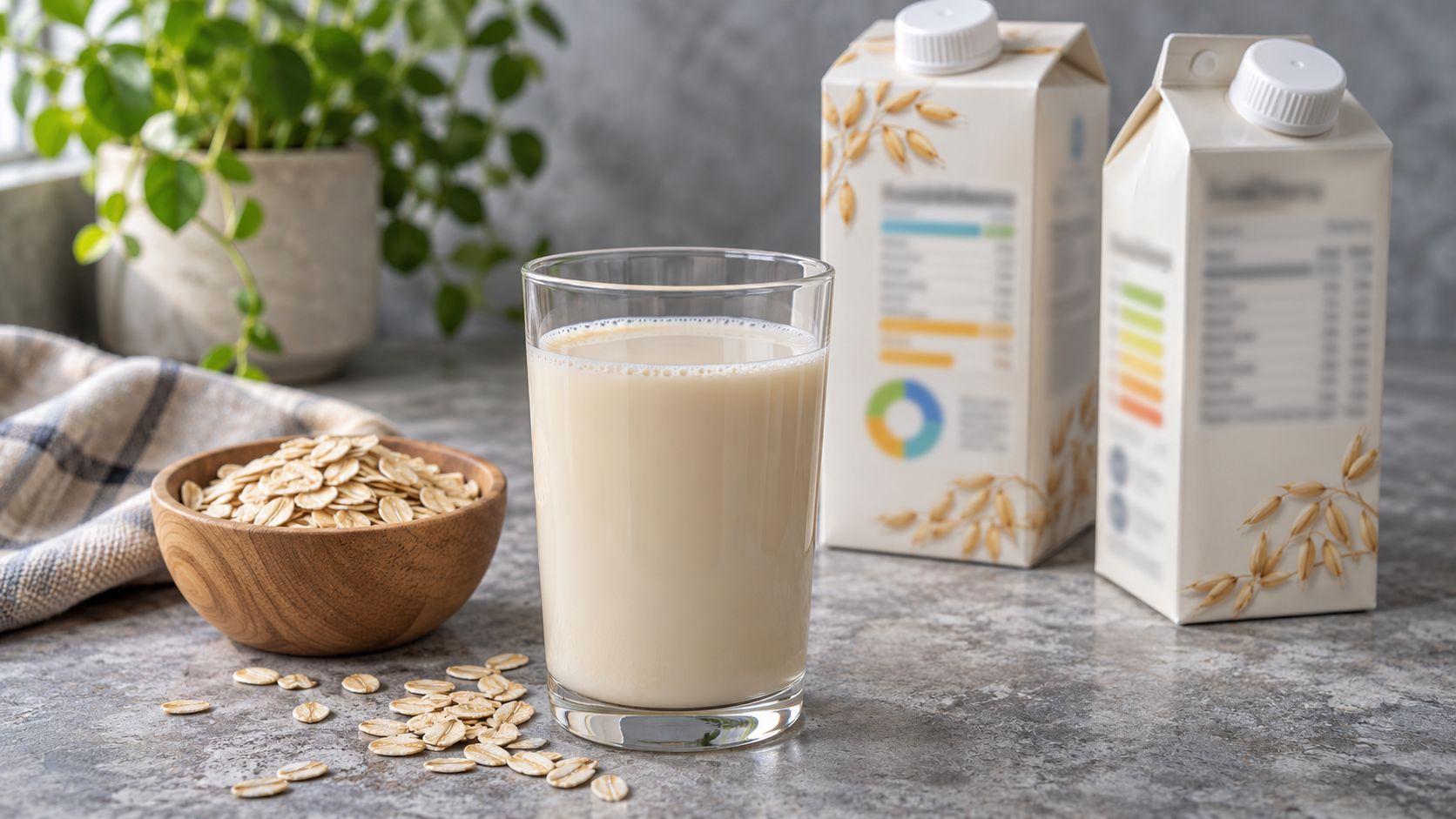
To compare two oat drinks, first determine what you’re buying them for. A product you’re considering adding a small amount to your coffee may have different criteria than a product you use in larger quantities every day. Next, convert the nutritional values of both to the same volume and read the ingredients list, storage instructions, and price. This guide explains how to compare packages available in the store. It doesn’t test or rate any brands or products.
Write down the product name and type of use.
Two packages may have the same brand name, one for the plain version and the other for the flavored or coffee-friendly version. For purchase notes, record the full name, package size, and type. When shopping online, match the photo of the front of the package with the photo of the ingredients. If one of the photos is of a different size or flavor, do not attribute the table to the same product. A brand name is not enough to identify the ingredients of all its products.
Make the use more specific than just “drinking.” For example, “every day in coffee,” “for weekend porridge,” or “a glass with breakfast” will clarify the volume and how quickly the package will be used. If you’re buying for coffee and frothing is important, compare the manufacturer’s description with your expectations. “Barista-friendly” refers to a functional feature, and you should read the table on the same package to find out how much protein, sugar, or calcium you have. If you’re buying for cooking, consider flavor and sweetness as well. Flavored products can change the taste of food.
Before comparing numbers, choose two primary criteria and one secondary criterion. For example, price per unit and simple taste are primary criteria, and package size is secondary. If the package is left open before it is completely consumed, it makes sense to switch priorities between unit price and package size. Write the criteria on the package before you see the ad so that each statement is evaluated in its own right.
Convert the table to the same size
Look at the top of the table and find the base of the numbers. One package may list the information per 100 ml and another may list it per 250 ml. Divide the second package number by 250 and multiply by 100 to get the amount per 100 ml. In the tutorial example, if there are 2.5 grams of protein in 250 ml, then there are 1 gram per 100 ml. This number is for illustrative purposes only and is not a product data sheet. [2]
Sometimes, the basis is not the volume of a serving, but its weight. Milliliters are a unit of volume, while grams are a unit of mass (weight). If one product lists values by weight and another by volume, do not attempt to calculate a numerical comparison without reliable conversion data. You may want to look for a different table for the same product or ask the manufacturer for the exact basis used for these figures. Also, distinguish between the “amount per serving” and the “amount per entire container.” A package that appears intended for a single person might actually contain more than one serving according to its label. [2]
The “Percent Daily Value” (%DV) can vary between different tables, depending on the specific labeling system used in that market and the defined serving size. For a direct comparison, if the values are provided in grams or milligrams, use these absolute amounts—ensuring you compare equal quantities (e.g., per 100g or per serving). When recording these figures, always note the unit next to each value. Keep calcium (in milligrams) and protein (in grams) in separate columns. Regarding sugar and salt, pay close attention to whether the label specifies “total sugars,” “added sugars,” “sodium,” or “salt.”
Consider the ingredient list and sugar information together.
The ingredient list reveals what the product contains beyond just oats and water. Ingredients such as oils, flavorings, texture modifiers, or fortifying agents can vary between different versions of a product. Simply seeing an ingredient on the list provides only partial information; for the specific amounts of protein, sugar, or fat, you must consult the nutritional table. However, if your goal is to avoid a specific flavor—such as vanilla—checking the ingredient list is usually a faster way to find the answer than looking at the nutritional table.
When comparing sweetness, distinguish between marketing claims, ingredient names, and the figures provided in the nutrition table. If the table lists both “total sugars” and “added sugars,” record both and ensure you are comparing them based on an equivalent serving size. If only “total sugars” is listed, the amount of “added sugars” cannot be determined from that figure alone. Official product information or a more legible version of the label may clarify what a specific claim on the packaging actually refers to. FDA guidelines for interpreting U.S. nutrition labels provide clear examples of these distinctions. For products from other markets, rely on the information provided on the packaging itself. [2]
If a product tastes sweeter to you when added to a glass of liquid or coffee, note your sensory impression separately from the figures on the label. Factors such as serving temperature, the flavor profile of the coffee, and the type of flavoring agent used can all influence your experience. For a home comparison, ensure you use equal volumes and the same base beverage. This personal experiment is intended solely to assist your own purchasing decisions; it does not constitute a laboratory test, nor can its results be generalized as a claim applicable to all consumers.
Evaluate fortification and protein content within the context of actual usage.
If the packaging contains a claim regarding calcium or vitamins, consult the nutrition table to identify the specific amount of that nutrient. The term “fortified” does not, by itself, specify the quantity. When comparing two products, note the listed amount, the serving size, and the units of measurement. If a nutrient is missing from the table, or if the units of measurement differ, record this ambiguity in your comparison notes. If a particular beverage is a regular part of your diet, the differences between various versions become more significant. [1]
The composition of plant-based drinks is influenced by the base ingredient, processing methods, and added components. Even if two products are both made from oats, their stated protein or micronutrient content may differ. Do not assume that the figures on one package apply to another product or to all oat drinks in general. When using these drinks in coffee, your actual consumption may be significantly lower than the standard serving size listed. If you wish to determine the exact amount you are consuming from a household glass or mug, calculate the value based on the actual volume of that container. [1] [2]
If you are making a selection to address a specific medical need or dietary requirement, discuss your intended purchase with a relevant specialist. While the nutritional information table can facilitate this conversation, it is not sufficient on its own to determine individual requirements. This is especially important when purchasing for someone with allergies or sensitivities; be sure to carefully review the ingredient list as well as any statements regarding potential cross-contamination. A “vegan” label does not necessarily provide information about allergens or the specifics of the production process. Always verify the criteria and scope of any certification label directly with the issuing organization. [3]
Keep a record of the price, shelf life, and the outcome of your purchase.
Divide the total price of the package by its volume and multiply by 100 to determine the cost per 100 milliliters. Ensure that you record prices based on the same time and retail location; if comparing across different stores, also note any shipping costs or discount conditions. If a larger package offers a lower unit price but you frequently fail to consume the entire contents, calculate the cost based only on the amount actually consumed. Comparing these two figures will help you select a package size that aligns with your actual consumption habits.
Read the storage instructions for both the unopened and opened states. Do not confuse the storage conditions for an unopened package with the recommended usage timeframe after opening. If the product is intended for multiple servings, write the date of opening on the package. If you spend a lot of time away from home or only use the product on weekends, a smaller package might better suit your needs. When purchasing online, ensure that the image showing the storage information is legible; you cannot determine the proper usage conditions for all products simply by looking at the shape of the packaging.
Create a separate entry for each product. Record the name and type, the date you examined the label, the package size, the reference unit used for the table, the specific values being compared, and the price. Include a brief note explaining why you deemed the product suitable—or unsuitable—for your specific needs. If the product’s formula or packaging design changes, repeat the comparison using the updated label next time. This approach ensures your shopping notes remain current and helps you keep track of differences between various versions of a product.
A practical comparison of two products in the store
Suppose you are evaluating two products, considering a daily serving size of one glass. Place the image of the front of each package alongside the image of its respective nutritional table, and distinguish between the total package size and the serving size. Create two rows in your notebook. First, record the price and package size; then, list the protein, sugar, and calcium content, ensuring all values are calculated based on the same reference unit. If calcium content is not listed for one of the products, write “Information not provided” in that space. Simply writing “zero” implies something different and could lead you to make an incorrect decision during your next shopping trip.
Now step back from the table and look at the application again. One package may be a better size for the task you are trying to accomplish, and another product may have a better number in one of the columns. Write down the reason for your choice in the note. If you bought the product, separate the amount used and the result of the application from the previous impression. For example, write down whether the package was used up in the recommended time and whether the taste in porridge was consistent with what you expected. This information does not take up space on the label, but it will help you to make your purchase criteria closer to the actual application next time.
Conclusion
Determine the use and volume. Read the ingredients list for ingredients and the table for amounts. Compare the sugar, protein, and ingredients listed in the same volume and list the unit price alongside the package size and storage conditions. For any product that does not have sufficient data, note the unclear item to check against the current package or manufacturer’s response.
Frequently asked questions
If the package says “no added sugar,” should I also read the sugar table?
Yes. Record total sugar and added sugar separately if both are reported. The front-of-pack statement does not contain all the information in the table. Use the same basis when comparing. [2]
How do I compare two tables with different share sizes?
Divide the number of each ingredient by the serving volume of the same package and multiply by 100. If both tables use consistent volumes and units, the numbers per 100 ml are comparable. Keep the unit next to each value.
Does “Barista-friendly” specify nutrient content?
For features such as foam and texture, see the manufacturer’s instructions. The nutritional information is listed in the product’s own table. Record the barista type as a separate copy and measure it against its own table.
What should I do if the table is not readable?
Record the full name, volume, and type of product and ask the seller or manufacturer for a clear photo of the label or information for the same version. Do not transfer information from another version to the current product.
Leave a Reply