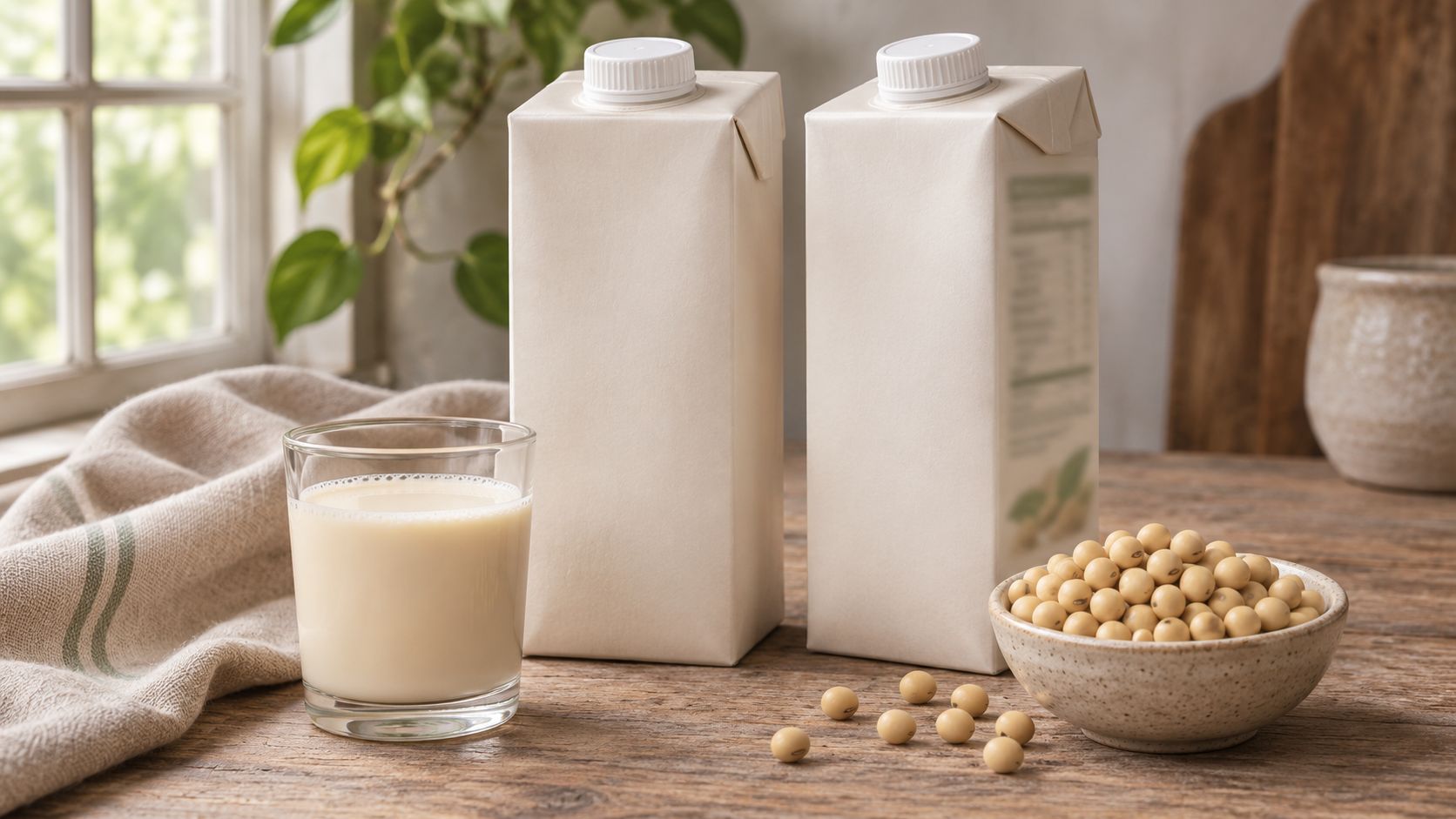
To buy a soy drink, first find out how much protein is in the amount you actually consume. Then, check what nutrients are added to the product and how much of each is in that amount. “Soy,” “no added sugar,” and “fortified” refer to three different parts of the product information. None of them replaces a complete table on their own. This guide shows how to read and compare labels and does not prescribe an individualized plan for choosing based on medical need. [1] [2]
First, clarify the use and dosage.
For someone who adds a small amount of soy drink to their coffee, the protein comparison in a full glass will differ from their actual consumption. If you usually have a glass with breakfast, measure or estimate the amount in that glass. If you are buying for cooking, calculate the volume for the entire recipe and then for the number of servings. Recording usage helps keep your purchasing metrics close to what actually happens at home.
Write two separate needs on your shopping list. One is the function of the product, such as a simple flavor for cooking or use in coffee. The other is a comparable feature on the label, such as the protein or calcium content. If multiple people are using the same package, consider the weekly volume of the household and the shelf life after opening. Buying a large package is more likely to fit into your schedule if you use it within the recommended time frame.
Along with the package size, note the exact name of the version. Plain, flavored, sweetened, and coffee versions may have separate tables and ingredient lists. If you only see a picture of the front of the package when shopping online, look for a legible picture of the back of the same package. Information you find on a page about a different version or market may not be enough for a product with a similar name. If the version has changed, use the new label as a basis for review.
Convert protein to equal volume
Read the top of the table to see if the amounts are reported per 100 ml, per glass, or per package. If one package gives the number in 240 ml and another in 100 ml, divide the amount of the first product by 240 and multiply by 100. Then add the two numbers together in grams per 100 ml. If one table is by weight and the other is by volume, conversion is required to get the correct data for the same product. [2]
After making a standardized comparison, calculate your own actual consumption separately. Suppose you have determined the amount of a specific nutrient per 100 milliliters; if your typical consumption differs from this, multiply that figure by the ratio of your actual portion size. In your notes, create two columns: one for “purchase comparison” and one for “my consumption.” The first column facilitates the comparison of product labels, while the second reflects your actual intake relative to the data provided in the table. [2]
If only the “Percent Daily Value” (%DV) is provided, ensure that the serving size and the relevant market standard are clear. This percentage represents the amount present relative to a specific labeling benchmark. When comparing products from different markets, looking at the absolute values—in grams or milligrams—for an equivalent volume provides a much clearer picture. If the absolute value is not listed, do not leave the space blank, as it might be mistaken for zero. Instead, write “absolute value not specified,” and if this information is a key factor in your decision, request clarification from the manufacturer. [2]
Evaluate the fortification of each nutrient individually.
The term “fortified” may refer to one or several nutrients. Look for specific nutrients—such as calcium, vitamin D, or vitamin B12—in the table and note each one separately. The presence of calcium, for instance, does not allow you to infer the levels of vitamin D or B12. The ingredient list is useful for identifying added components, while the table provides the declared quantities. Review both sections together, and be sure to record the specific product version and the date you accessed the information in your notes. [1] [2]
In the ingredient list, fortifying compounds may be listed as a vitamin and mineral blend, or they may be listed individually by name. If only the name of the compound appears, refer to the nutrition table to determine the amount per serving. If the table does not specify the quantity, do not attempt to estimate it based on the ingredient’s position in the list. The name of a compound and the specific nutrient content are two distinct pieces of information. When making personal decisions regarding the intake of a specific nutrient, one must also consider the actual amount consumed and the context of the rest of one’s diet. [1]
A soy-based product may differ from another product within the same category. Processing methods, dilution, and added ingredients all influence the final composition. When evaluating a brand for the first time, do not substitute data from a different product for the specific version you have on hand. If the manufacturer recommends shaking the container before use, or specifies particular storage conditions, follow the instructions provided on that specific package. Documenting the serving method allows for a more accurate estimation of the actual amount consumed. [1]
Converting serving-based data from the nutrition table into a standardized quantity.
According to the official website for the U.S. version of “Silk Unsweet Soymilk” (reviewed on November 8, 2026), a single serving is 240 milliliters. For this serving size, the manufacturer lists 8 grams of protein, 470 milligrams of calcium, and 3 micrograms of vitamin D. To calculate the protein content per 100 milliliters, divide 8 by 240 and multiply the result by 100. This yields approximately 3.3 grams of protein per 100 milliliters. Using this method, the calcium content is approximately 196 mg, and the vitamin D content is about 1.25 mcg per 100 ml. [3]
If only 60 ml of this product is used in coffee, this amount represents one-quarter of the serving size listed on the label. Consequently, the calculated protein content in the prepared drink is approximately 2 grams. This conversion is based on the figures provided on the label and is not the result of laboratory testing. This example cannot be used to infer the nutritional content for other individuals or for other products available on the Iranian market. If you encounter a product with a similar name, please refer to the specific serving size and nutritional figures provided on that product’s packaging. [3]
Do not use this example to create a ranking. When making an actual purchase, other factors—such as price, the feasibility of consuming the entire package, or the need for an unflavored product—may be more relevant. This example simply illustrates how to use the manufacturer’s data to compare products based on an equal volume. This guide does not account for factors such as taste, texture, stability when added to coffee, or the bioavailability (absorption rate) of nutrients. If you decide to try a product for personal use, keep a record of the specific brand, the amount used, and the method of consumption.
Also, check for sugar, allergens, and preservatives.
Beyond protein and fortification, if sweetness is a concern for you, check for “total sugar” and “added sugar” (if listed separately). Do not attempt to determine the presence or absence of added sugar based solely on the total sugar figure; the ingredient list will clarify whether any sweeteners or flavoring agents have been included. If the nutritional table provides only a single figure for sugar, record it exactly as labeled by the manufacturer. When comparing oat drinks, start by ensuring that the units of measurement and the column headings are consistent. [1] [2] How to compare oat drink labels
Soy presents a distinct issue for individuals with an allergy to it. If you are purchasing for someone else, take into account the ingredient list, any warnings on the packaging, and the advice of their physician. The term “plant-based” does not provide sufficient information regarding allergy risks. If the product is intended for a young child or for someone with specific medical needs, do not rely on the comparison of a single nutrient to determine a suitable dietary substitute. FDA guidelines emphasize the variations in the composition of plant-based beverages and the special considerations that apply to young children. [1]
Check the storage instructions for the product after opening; these may differ from the conditions required for an unopened package. If you intend to use the product solely for coffee, consider whether the remaining quantity can be consumed within the recommended timeframe. Also, compare prices based on the usable volume. In your shopping notes, you can record details for each package, such as its name, date, volume, price, protein content, and any added nutrients. If any part of the nutritional table is unclear, decide whether you need to ask the seller for clarification or if you can make an informed decision without that information.
Compare two labels side-by-side to make a well-informed decision.
Suppose you want to select a product for cooking and weekly breakfasts. First, identify the two specific options you are considering. Standardize their nutritional tables to a 100-milliliter serving size and determine which values are most important to you. Next, look at the package size and assess which option aligns best with your frequency of use. If one option appears more cost-effective but leaves a large surplus, re-evaluate the cost based on the amount you will actually consume. Do not include information that is missing from the label in your comparison.
For repeat purchases, keep only the numbers that really change the choice. If you’re buying a beverage for occasional use in coffee, the package size and unsweetened flavor may be more important to you. If it’s a fixed portion of a serving, comparing the amount of protein and micronutrients listed can help you review your eating pattern. Whenever the recipe changes, do the calculation for the new data.
If you are buying for several people, write down where each person usually drinks and how much they usually drink. The total household consumption is used to choose the size of the package, and the amount each person uses to understand their share. If in practice the package runs out later, change the size of the next purchase. This simple overview helps you read the number on the label and the unit price along with the storage conditions and actual consumption.
Conclusion
Compare the protein and added nutrients in the same volume and then get them for your actual consumption. Read the ingredient, sugar and preservative lists separately. Don’t use the label of one recipe to draw conclusions about all soy drinks.
Frequently asked questions
Is every soy drink fortified?
The composition depends on the recipe. Read the label for the name of the added ingredient and its amount in a given serving. If only one ingredient is listed, do not infer the presence or amount of others. [1]
How do I compare two tables with different share sizes?
Divide the number of each ingredient by the serving size of the same package and multiply by 100. Keep the units. This conversion is comparable when both sizes and serving sizes are consistent. [2]
Does the phrase “no added sugar” indicate the amount of protein?
No. The protein content in the table is the same as the product. For sugar, read the difference between total and added sugar if listed and confirm the serving size. [2]
Can I use another version of the brand name?
Match the exact name, size, and market. Do not transfer information from a plain, flavored, or country-made version to another package. If the photo is not legible, ask the manufacturer for information on the same version.
Leave a Reply