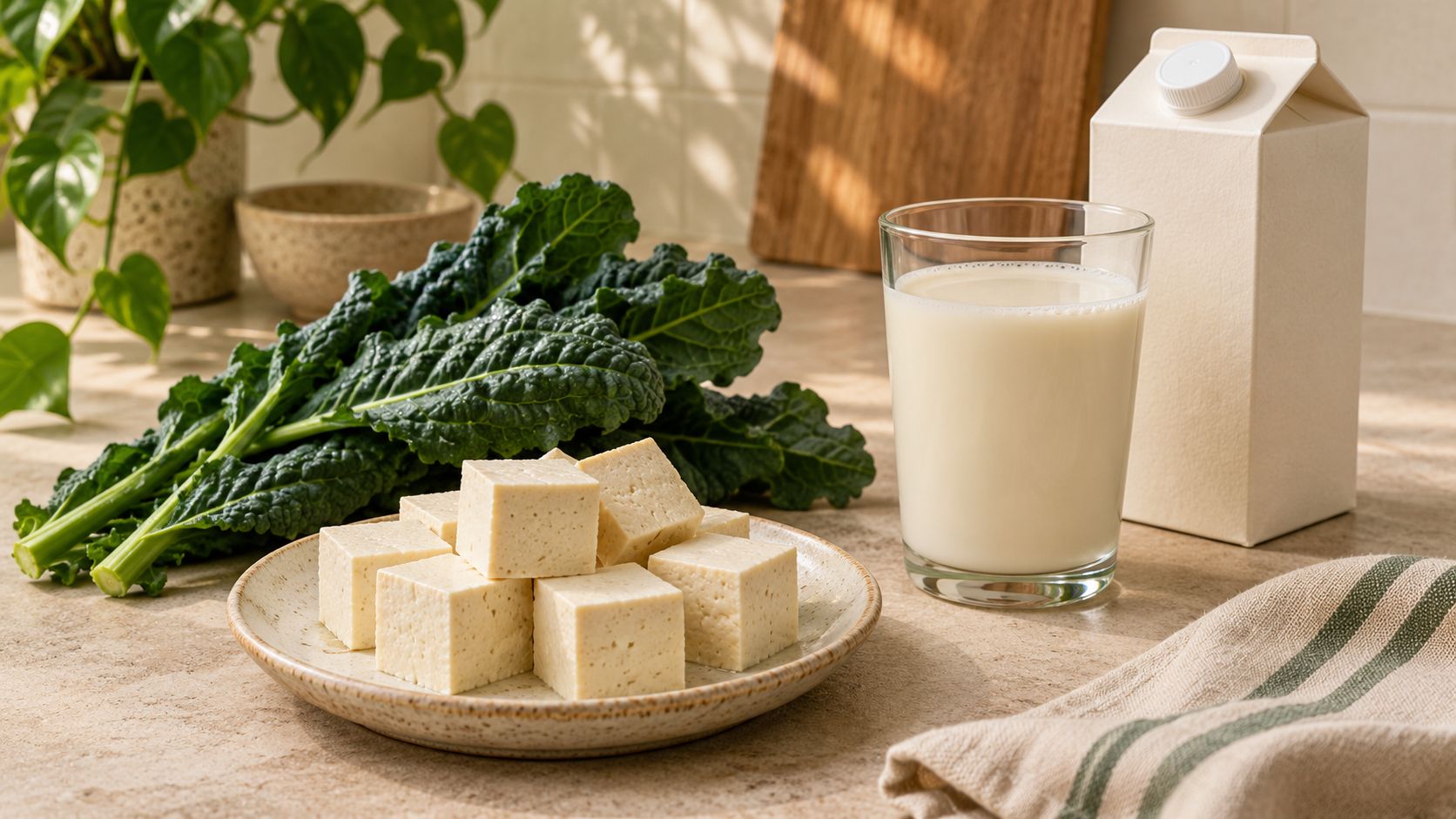
Check calcium in the amount you actually eat. Fortified drinks, calcium-set tofu and some vegetables can contribute, but their values and the amount your body can absorb are not all the same.
Build a picture of what you eat
If you stop using milk, yogurt or cheese, start by asking which of your old meals supplied calcium and how often you ate them. A splash of milk in coffee is a different habit from a bowl of yogurt most mornings. A useful replacement has to fit the meal as well as the nutrient you want it to provide. Replacing something you rarely ate will make less difference than choosing a reliable option for a food you used every day.
Write down several typical days rather than a day you chose because it was unusually tidy. List your drinks, spreads, main dishes and snacks, including brands for foods that are fortified. Mark the foods you already buy that list calcium in their nutrition information. For vegetables or other foods that do not come with a label, use a named food composition database appropriate to your country and to the form you eat. Fresh, cooked and drained weights can describe different things.
This exercise is a way to see patterns. It is not a diagnosis of deficiency or a reason to start a supplement. A package label describes the food. It cannot tell whether you absorb enough calcium or whether you have another health issue. If you have a medical condition, are planning food for a child, or have been advised to change calcium intake, ask a qualified clinician or dietitian for advice that takes those circumstances into account.
Read the label in units you can use
Calcium is commonly given in milligrams. Some products give the amount per serving, others per 100 milliliters or per 100 grams, and some give a percentage of a local reference value. Start by finding the unit. A percentage can help compare foods under the same labeling system, but it is not automatically the same amount in another country. When both values are available, use milligrams for direct comparisons and keep the serving size beside the number.
Here is a made-up calculation, not a value for a named product. If a carton gives 120 milligrams of calcium per 100 milliliters and you pour 200 milliliters, the amount for your glass is 240 milligrams. If you pour 50 milliliters into coffee, the same carton gives 60 milligrams in that portion. Conversely, if a label gives 240 milligrams for a 200-milliliter serving, divide by two to get the value per 100 milliliters. This is useful when two products use different serving sizes.
You only need to measure your usual portion once or twice to see whether the label serving is a useful proxy. Fill your everyday cup or bowl as you normally would and transfer the liquid to a measuring jug. For a block of tofu, estimate how many portions you divide it into and compare that weight with the label. A rough quantity that reflects your actual meal is more useful than a precisely copied number for a serving you seldom eat.
Fortified drinks and other fortified foods
A plant drink may have calcium added during manufacturing. The NIH Office of Dietary Supplements lists some fortified soy drinks as examples, but fortification varies by product and country. Read the nutrition panel and the ingredients for the exact carton. A product that uses a word such as almond, oat or soy in large type does not tell you how much calcium it contains. A package that looks nearly identical may contain a different recipe or be sold under different rules.
Compare both the nutrient and the job you want the drink to do. An unsweetened fortified product might suit porridge or a savory sauce. A different product may suit tea because you prefer the taste or texture. Calcium alone does not make two drinks nutritionally equivalent; protein, sugar and other added nutrients can differ. If you are replacing a regular part of meals, check the rest of the label as well. Follow directions to shake or store the drink if the manufacturer provides them.
Fortified foods can also include some cereals and other products. Check how much calcium a realistic serving contains and how often you eat it. A food you choose only during travel is less reliable as an everyday source than a breakfast item you keep in the cupboard. Conversely, do not dismiss a useful fortified food simply because it is convenient. If it fits your budget and your meals, that is part of what makes it workable.
Tofu and vegetables: why similar foods can differ
For tofu, the ingredient list can tell you which coagulant was used to make the curds. Calcium sulfate is one example of a calcium-containing coagulant. The NIH fact sheet notes that tofu made with calcium salts can provide calcium, whereas varieties made with other salts may supply much less. If the label provides milligrams, use that figure for your product. Do not copy the number from a different block or from a recipe that does not say which tofu it uses.
Some leafy vegetables, including kale and bok choy, contribute calcium. A portion can also give you variety, and these vegetables can be useful ingredients in soup, a grain bowl or a quick stir-fry. Comparing leafy vegetables by a single large number can be misleading, however. A label or food database reports the amount present in the food. It does not normally tell you how much an individual will absorb from the finished meal.
Spinach is an example of why that distinction matters. It contains calcium, but its oxalate can bind to calcium and reduce absorption from that food. The NIH fact sheet contrasts spinach with lower-oxalate vegetables. This does not make spinach a food to avoid. It means that a daily plan built on spinach alone is a poor interpretation of a table of total calcium. Use a mix of sources, including ones you can check and serve regularly.
Put several sources into meals you want to eat
Suppose breakfast usually consists of oats, fruit and a drink. Look at the calcium in the drink you pour into the bowl and decide whether you can buy it regularly. At lunch you might eat a sandwich with no major calcium source. That is not a reason to redesign the whole lunch if dinner is usually tofu with vegetables. Check the meals together and look for a simple habit that can continue even when plans change.
If you seldom buy plant drinks, try a different starting point. Make a tofu dish using a product whose label you can read, or use vegetables you enjoy as one of several sources. A supermarket may stock multiple sizes, so check cost per portion as well as the advertised price. If you buy food in small amounts and it frequently goes to waste, a product with a smaller pack or a shelf-stable unopened option may be a better practical choice.
Restaurants and foods from a bakery are harder to quantify. A creamy texture in soup does not reveal whether a fortified plant drink was used, just as the word tofu on a menu does not reveal its coagulant. If you do not know, leave that amount unknown rather than filling in a value from a package you buy at home. A flexible plan should work without treating every meal away from home as something you can measure precisely.
Keep individual needs and supplements separate
How much calcium is appropriate depends on age and other circumstances, and dietary recommendations and label reference values are not interchangeable. A calcium value printed on food is not a personal target. Check your local public health guidance or ask for individual advice if you are unsure which recommendation applies. This is especially useful if your diet excludes several food groups or if the advice you have received about calcium is specific to a medical condition.
Vitamin D helps the body absorb calcium, as the NIH fact sheet explains. It is worth checking that your overall diet plan accounts for both nutrients, but this does not mean that the presence of vitamin D on a label guarantees you need no other source. Nor can a calcium figure establish whether a drink has added vitamin D. Look at each item on its own. If you use supplements, record which products and amounts you use before discussing them with a clinician.
Do not try to fix an uncertain food estimate by automatically adding several supplements. Products may already overlap, and calcium supplements can interact with some medicines. The safest useful first step is to bring concrete information: photographs of the labels, the amounts you actually use and the names of any supplements or medicines. That gives a qualified professional something to assess and avoids turning a shopping guide into a treatment plan.
Make the next grocery trip easier
Pick one item that you buy often and compare two versions using the same unit. Read the ingredient and nutrition information, then estimate what you will use in one meal. Decide which version you would actually choose again. If a favored product does not supply the amount you thought it did, keep it for the uses where you like it and identify a different source for your calcium plan.
Once you have a reasonable pattern, save it as meals rather than a list of numbers. For example, note the fortified drink you use with oats and the tofu you use in a particular dinner. Check labels again when the packaging, recipe or supplier changes. That small habit catches changes that an old screenshot or a general nutrition table will miss.
Compare two labels before choosing
Imagine that the calcium figure for carton A is 200 milligrams per 200 milliliters and the figure for carton B is 120 milligrams per 100 milliliters. At first glance the number on A looks larger. When both are expressed per 100 milliliters, A gives 100 milligrams and B gives 120 milligrams. If your usual portion is 150 milliliters, these examples give 150 and 180 milligrams, respectively. These invented numbers show why you should bring products to a common unit before comparing them.
Now change the question. Suppose you like one drink in porridge and would only use the other in small splashes. The carton with more calcium per 100 milliliters might provide less in the way you actually use it. The useful quantity for your plan is the amount in a real portion, multiplied by the number of times you are likely to use it. Try an ordinary breakfast for a few days before deciding whether that product is a reliable part of your routine.
There is another distinction between a food comparison and a diet assessment. The label helps you choose between two drinks, but it does not capture all the tofu, vegetables and other foods you eat in a week. You can use the same arithmetic on other packaged foods and leave unmeasured meals blank rather than assuming they contribute nothing. If you are keeping a record for a dietitian, take a picture of the package and note your portions. That is more informative than writing down a number without the label it came from.
Estimate without mistaking the estimate for certainty
If you want to see how regular the pattern is, look at several ordinary days that include both workdays and a weekend. A carton that you use every morning is easier to count than a product you sometimes borrow or buy in a café. Write the amount in milligrams for foods you can verify, with the label serving or actual portion beside it. For foods you cannot quantify, write unknown. Do not replace an unknown with zero, because that would turn incomplete information into a misleading total.
A rough record can still answer useful questions. If most of the calcium you can verify comes from one carton, check whether there is another product you can use if the store stops carrying it. If a food is bought regularly but people in the household use different quantities, estimate your portion instead of dividing the entire package equally among everybody. If the same tofu is used in two dinners, record the share of the block you actually eat at each dinner.
When labels change, retain the old note only as a record of the old product. For example, if a manufacturer changes the carton to a different serving size, redo the conversion rather than assuming that a larger printed amount signals a stronger formulation. If the calcium is no longer listed, contact the manufacturer or use another clearly labeled product for the purpose of your calculation. A visible figure makes the shopping decision easier to repeat.
You can use a notebook or a photograph of two labels; no special tracking app is required. The aim is to find whether your regular sources are identifiable and practical. When the result prompts a health question, take the record to a dietitian or other qualified professional rather than trying to infer your calcium status from several days of meals. A good record separates what you ate, how you estimated it and where information is missing.
Summary
Compare calcium in the portions you eat and use the exact product label where possible. Fortified foods, tofu made with calcium salts and certain vegetables can contribute. Calcium content and absorption describe different things. Build a repeatable mix of sources and get individual advice where your needs go beyond general food planning.
Frequently asked questions
Is every plant drink fortified with calcium?
No. Look for the nutrient in the nutrition information for that carton and note its unit. A calcium salt in an ingredient list can tell you something about the formulation, but a quantified amount makes comparisons easier.
Does all tofu provide the same amount of calcium?
No. Formulations differ, including the type of coagulant. If your label has a calcium figure, use it. If it does not, do not treat a number for a different tofu as a measurement of yours.
Is it enough to include one high-calcium food?
That depends on the food, the portion, how often you eat it and your individual needs. Several sources that fit your routine give you a plan you can use even if one product is out of stock or a meal changes.