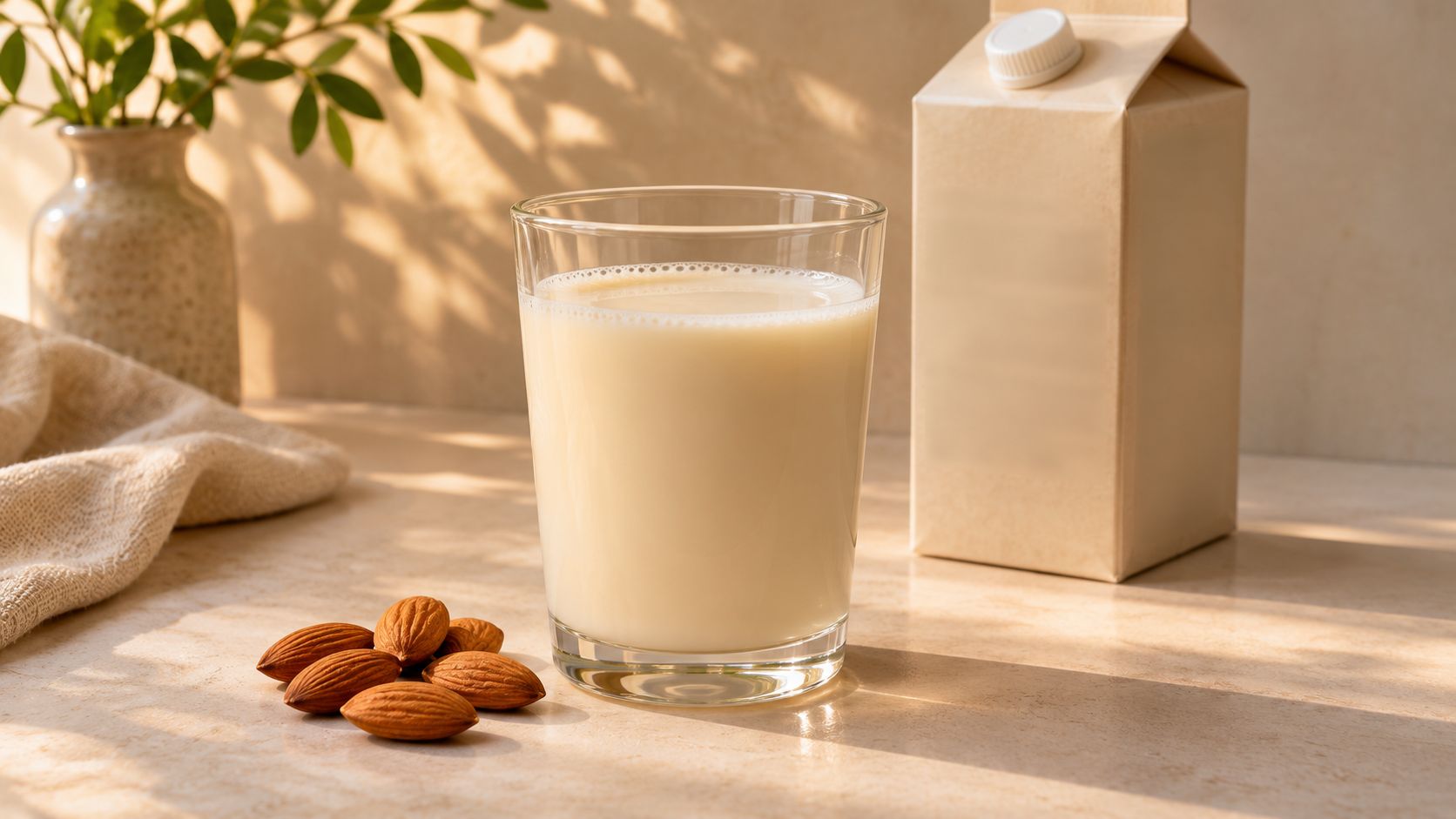
Compare almond drinks in the same quantity. Then look at the portion you will actually pour, the ingredients that matter to you and any nutrients you expect the drink to supply. A plant-based name on the front of the carton is not a substitute for that comparison.
Start with the job you want the drink to do
Think about why you are buying the drink. A splash in coffee, a liquid for porridge and a glass at breakfast are different uses. A product you like in coffee may have a texture you do not want in a sauce. A carton you buy to provide calcium should be judged partly by how much calcium it supplies in the portion you drink. There is no single ranking that covers every use, taste and budget.
Make a short list of information you will actually use before standing in front of the shelf. If you have an allergy, the first decision is whether the product is suitable. If you use a large serving in a meal, nutrition information may be more relevant than it is for a few drops in tea. If you rarely finish an opened carton, package size and storage instructions can decide whether buying it is practical.
The US FDA’s comparison of milk and plant-based beverages emphasizes that products vary nutritionally. That is true even among drinks with the same plant in their name. The FDA examples describe US labels; your local label may present information differently. The method here works with common units when those units are actually given, and it leaves unknown values blank rather than assuming that every carton lists the same nutrients.
Read the ingredients in context
Find the ingredient list on the exact carton. Look for the named plant ingredient, sweetening ingredients, added oils, salt, ingredients that affect texture and any added vitamins or minerals. You do not have to recognize every term to make a useful comparison. First identify the ingredients relevant to your reason for buying the drink. Then check any unfamiliar ingredient if it would change your choice.
Some labels give the percentage of almond. If both products disclose it on the same basis, it can help you compare what they say about their formulation. It does not automatically tell you which one has more protein or calcium. Added nutrients and processing can affect the finished drink, and the nutrition panel provides a separate piece of information. Do not infer nutrient amounts from the almond percentage or from the picture on the front.
Products may use thickeners, emulsifiers or oils to help create a particular texture. A smoother texture might be what you want in one use and unnecessary in another. An ingredient list tells you that a substance is present, but it usually does not tell you exactly how much of it you consume. There is no need to label a product good or bad just because its list is longer. Read the list for your own decision: flavor, diet, allergy or a practical kitchen use.
Put serving sizes on the same basis
Look for the line that says per 100 milliliters or per serving. A carton might give a serving of 240 milliliters, while a second lists only a value per 100 milliliters. Do not compare the printed numbers directly. Divide the amount by the serving volume and multiply by the volume you want to compare. For a comparison per 100 milliliters, the multiplier is 100. For your usual glass, use the number of milliliters in that glass.
Here is an invented example. If a drink supplies 3 grams of protein per 250 milliliters, it supplies 1.2 grams per 100 milliliters. Another drink with 1 gram per 100 milliliters supplies 2.5 grams in 250 milliliters. The label values are not contradictory; they were written for different quantities. Once you put them on the same basis, you can see which has more protein for the same amount of liquid.
Now check what you actually pour. If you use only 40 milliliters in coffee, a value given for a full glass will overstate what that drink contributes to your day. If you use it in porridge, measure one of your usual pours and write that volume beside the label. When more than one person shares a recipe, divide the total amount among the portions you actually serve. That estimate is usually more useful than assuming everyone drinks one labeled serving.
Compare sugar, protein and fortification separately
If you want an unsweetened drink, check the ingredient list as well as the nutrition panel. A sugars line may report total sugars. Depending on the market, a separate line may identify added sugars, or that information may not be presented in the same way. Do not assume that total sugars and added sugars mean the same thing. A word on the front about sweetness can be a useful cue, but the ingredients and the nutrition information help explain what it means for that particular product.
If the drink is supposed to provide protein, compare grams in a realistic serving. The FDA notes that the nutrient profiles of plant-based beverages vary; some drinks contribute little protein compared with others. A low-protein drink can still be useful for cooking or taste. If you planned for it to provide a substantial part of breakfast, decide which other food will supply protein or compare it with another product that fits your dietary needs.
For calcium and vitamins, check the label rather than assuming all almond drinks are fortified. Look for the named nutrient and a measured amount or a local reference percentage. A percentage is easiest to compare within the same labeling system. If you find a milligram or microgram amount, keep the serving size attached. The presence of one added nutrient does not imply that another is present. Read calcium, vitamin D and vitamin B12 separately when they matter to your meal plan.
Treat allergy and special uses as separate decisions
An almond drink contains an ingredient made from almonds. People who need to avoid almonds should not rely on a product’s plant-based or dairy-free wording to decide that it is safe. The allergy statement and ingredient list answer a different question from the front label. Labeling rules and advisory wording can vary. If cross-contact is a concern or the information is unclear, follow the advice you have received for managing the allergy and contact the manufacturer when needed.
Check the exact size and flavor you are buying. A carton from the same brand may use a different ingredient list, and a barista version may be formulated for a different texture. If the product will be used by several people, make the package available rather than relaying only the product name. In a café, ask for the original carton if you need to check the ingredient list. When that is not possible and the risk matters, choose an option you can assess.
This is a guide to comparing retail drinks for ordinary food use. A plant drink is not infant formula. If you are choosing a beverage for a young child or replacing a food on medical advice, check the guidance for that age and situation rather than applying a serving example written for adults. Take the label with you if you seek advice so that the person helping can look at the actual product.
Include the cost and opened storage in the comparison
Compare price per liter when packs differ in volume. Divide the price by the volume in liters. That comparison does not tell you how much of each carton you will actually use. If you pour a small amount in drinks and discard the rest, a smaller carton may cost less per usable portion even when it costs more per liter. Use the quantity you will realistically finish, not the volume you hoped you would use.
Follow storage directions after opening, even for a product that was stored at room temperature before you bought it. Some packages give a time limit as well as a refrigeration instruction. Write the opening date on the carton if several people share the refrigerator. If the label tells you to shake before use, make a habit of it so that the first and last pours are closer to the intended product.
Do not decide the storage period for all almond drinks from the one you currently buy. A shelf-stable carton and a refrigerated carton can have different instructions. The relevant information is on the product you have in the kitchen. If you are trying a new drink, buy the size that gives you time to use it according to the instructions rather than stocking up before you know how it fits your routine.
A worked comparison at the shelf
Suppose two cartons both fit your allergy and dietary requirements. Carton A lists 100 milligrams of calcium per 100 milliliters and costs 3 units for one liter. Carton B lists 150 milligrams per 150 milliliters and costs 2 units for half a liter. On a common basis the calcium values are the same, and the price per liter is 3 for A and 4 for B. These are invented numbers, so the comparison is about the method rather than a recommendation to buy either carton.
Now suppose you use 100 milliliters on each of four mornings and the opened storage instructions fit that plan. You would use about 400 milliliters. If you discard everything you do not use, you would spend 3 units for 400 milliliters with A and 2 units for the same used amount with B. If the larger carton can also be used in a family meal within the allowed storage time, the decision can change. The most useful measure depends on how you use the product, not only the shelf price.
Keep your comparison for the next trip only as long as the label still matches. Manufacturers can reformulate products. If the packaging, ingredient list or flavor changes, check again. You do not need to repeat the calculation for every carton you buy; use it when there is a real choice or a nutrient you want to count.
Compare products in the way you will use them
A drink that suits a savory dish needs to work with the other ingredients in it. Plain, unsweetened products are a useful place to start if you do not want a sweet or vanilla flavor in a sauce. Try a small quantity in the finished dish before changing the whole recipe. For a coffee, pour the same amount into a cup prepared the same way and notice the taste and texture. This is a household comparison, not a test that establishes which product performs best in every kitchen.
A barista formulation may be intended for a particular texture when heated or foamed. That description does not tell you what is in the carton or whether it supplies the nutrients you want. If you compare a plain version and a barista version from the same brand, read each list separately. Keep price, taste and nutrition as separate notes. You can reasonably prefer one for coffee and buy the other for a meal, or use a single product if keeping several opened cartons would lead to waste.
Try a one-week record if you are not sure how much you use. Write the opening date, estimate the volume you used in a few ordinary days, and check how much was left while the product was still within its instructions. That tells you whether your next purchase should be smaller. For a family carton, note that the product may be used in coffee, breakfast and cooking. A large pack can make sense when it has several planned uses; a small pack may suit a household that uses it for only one.
If you are buying a drink primarily for a nutrient, first make a short comparison of relevant products, then look at whether any fit your budget and the meal. There is no need to force one product to solve every problem. For example, you might prefer a particular almond drink for taste and get calcium from another reliably labeled food. A clear decision about the purpose of each food prevents you from assuming that a pleasant drink has the same nutrition as the food it replaces.
When the carton has no figure for the nutrient you care about, compare only what you can verify. You can look for manufacturer information for that exact product, but check the country and the package size before treating a website as a match. If there is still no usable value, write that the amount is unknown. This is more accurate than copying a figure for a similar drink and more useful than declaring it absent solely because a number is not shown.
When you find a product that works, save enough information to identify it again: the brand, flavor, exact formulation and the unit on its nutrition panel. If you are shopping online, confirm the information on the delivered package, particularly when allergy or fortification matters. A thumbnail can show older packaging. Keeping the old notes as a starting point and checking the current carton gives you a repeatable routine without turning each purchase into a full comparison.
Finally decide what would prompt you to look again. A change in price, available pack size or formulation may be enough. If the carton still fits your ordinary use, you do not need to re-evaluate the whole category every time you shop. The method is there to answer a real question: whether this drink, in the amount you use, does the job you bought it to do.
Summary
Begin with the intended use and any allergy requirements. Compare the ingredients and nutrition information of the exact products, and convert values to the same volume. Then check your real serving, any fortification you need, the cost of what you will use and the directions after opening. Leave unknown values unknown.
Frequently asked questions
Does a higher almond percentage guarantee more calcium?
No. The amount can depend on the formulation and added calcium. Use the stated nutrition value when available and compare the same volume.
Does unsweetened mean the product has no sugar at all?
Not necessarily. Read what the label reports for sugars and check the ingredients for sweetening ingredients. Label terminology can differ by market.
Can I compare a percentage on one carton with milligrams on another?
You can compare them only if you know the reference amount behind the percentage and account for the same serving volume. If you do not have that information, use the same type of value when possible.