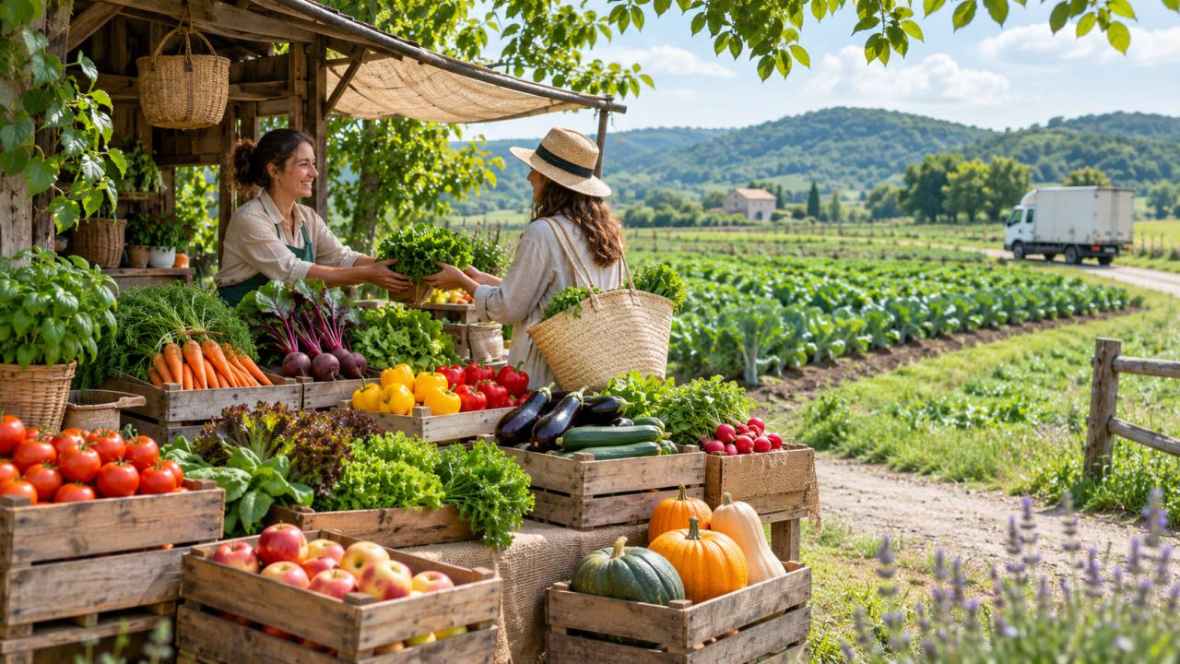
Distance is one part of a food’s environmental impact. To compare a local option with a more distant one, check how both were produced, moved and stored. Use the same amount of usable food and the same environmental measure.
Decide what local means in the comparison
A shop might call a product local because it was grown nearby, because it was packed in the region or because the company is based there. These descriptions are not interchangeable. If distance is part of the claim, ask where the food was actually produced and which part of its journey the distance describes. For a product made from several ingredients, the place of manufacture may tell you little about where the ingredients came from.
Define the two options in ordinary language. For example, compare a particular seasonal vegetable from a nearby grower with the same type of vegetable sold by another supplier. Note the time of year, product form and intended use. A comparison between a fresh untrimmed vegetable and a prepared frozen one may need different weights to represent what you will eat. The word local does not resolve that difference.
The main question may not be environmental. You might value buying from a producer you know, prefer the quality of a particular item or want to support a local business. Those can be reasons to choose it. They do not establish a lower greenhouse gas footprint. Keep the reason for your choice and any environmental claim separate so that each can be assessed on its own evidence.
Pick one measure and a common quantity
A food can have effects on greenhouse gas emissions, land use, water resources and other environmental measures. The comparison can come out differently depending on which measure you choose. An option with a lower climate impact does not automatically use less scarce water. If a claim says only that one option is greener, ask which indicator supports it and which stages were counted.
Use a common reference amount. A kilogram of food harvested, a kilogram sold and a kilogram eaten can represent different things when food is trimmed or lost along the way. If you want to compare the effect of buying ingredients for a meal, look for values that can be converted to the amount actually used. If one estimate is for raw produce and the other for cooked produce, check how the source treats the change in weight.
Avoid combining values that describe different boundaries. A farm-gate estimate can stop before delivery or storage, while a retail estimate may include them. The first number is not lower simply because the product performs better. It may have a shorter accounting boundary. When the sources do not provide enough information to make the values comparable, describe the estimates separately and say what is missing.
Look at production conditions
A crop can have different impacts depending on yield, heating, fertilizer, irrigation, energy source and other growing conditions. Poore and Nemecek’s life-cycle study found substantial variation among producers. This matters when comparing a local and a distant product. The average for a food category is useful for context, but it cannot identify exactly how a particular grower produced your purchase.
Take a hypothetical comparison between vegetables from a heated greenhouse nearby and vegetables grown outdoors farther away. The greenhouse uses energy for heating, while the distant vegetables require a longer journey. You cannot decide which has lower emissions from those facts alone. You would need to know how much heating was used, its source, how much saleable food each system supplied and how the distant product was moved. A different result is possible when any of those inputs changes.
Season and location interact. A product can be grown near you in one season with little additional heating and supplied from a different system in another season. Ask whether a study’s dates match the decision you are making. A photograph of a local farm or a general statement about growing conditions does not describe every batch. If a vendor can explain the season and method, that is useful evidence for a narrower claim.
Follow the transport route, not only the distance
Transport emissions depend on factors such as the vehicle, fuel, load and cooling requirements. A distance on a map does not reveal how a product traveled. A larger shipment can carry more food per trip than several smaller ones. Air transport, road transport and shipping can produce different results for the same distance. Before making a claim based on kilometers alone, check what mode and route the estimate assumes.
Weber and Matthews studied the relative contribution of production and transport to food-related climate impacts for US households. For the aggregate and period in their analysis, production was the larger contributor. The result helps explain why food miles are incomplete. It does not tell you that transport is unimportant for every product, and it should not be applied as a fixed proportion to a specific local food.
Ask about the last stage of delivery as well. A delivery from a local grower to a shared market and a customer driving separately to buy one item are different arrangements. A household trip that was already planned may be allocated differently from a trip made solely for the food. If a study counts those trips, check the assumption. If it does not, say where the transport estimate stops.
Include storage and food loss where relevant
A food sold close to where it is grown might still spend time in a cold store. A food transported farther might be moved and stored in a system that prevents damage or spoilage. Both possibilities matter. The joint UNEP and FAO report on food cold chains describes energy use and refrigerant emissions as well as the potential to reduce food loss. Those effects need to be considered together when the comparison depends on cooling.
Imagine that two options start with the same quantity of harvested produce, but one delivers less usable food because more is damaged. A comparison per harvested kilogram may hide that difference. If the decision is about the food people can eat, count the edible amount. Reducing losses can change the amount that needs to be grown, delivered and stored for the same number of meals. The calculation depends on actual loss data or clearly identified assumptions.
At home, choose the quantity you can use and the form that suits your storage. A fresher product can be useful if you will cook it promptly. A frozen option can help a household that takes only a little from the pack each time. These are practical observations. Without more data, they do not prove a universal result about the relative environmental impacts of fresh and frozen food.
Use a small worksheet at a market or shop
Write down the product, production location, season and form. If the vendor knows how it was grown or transported, record that. If the answer is unclear, leave it unknown. Next write the amount you expect to use and the indicator you care about. These notes show what you know before you try to compare numbers. They also reveal when a claim is based almost entirely on the word local.
For a household purchase, you may not need a footprint figure. If you have a choice between two options and neither has reliable data, you can still buy the amount you will eat, choose a product in good condition and store it appropriately. If you are writing or repeating an environmental claim, the standard is different. A claim about one option being lower needs comparative evidence and a clear scope.
For a community kitchen or retailer, ask suppliers for information appropriate to the size of the decision. You might need data about production method, the route, quantities and loss. If both suppliers use the same standard, the comparison may be easier to interpret. If methods differ, state that limitation. A spreadsheet with one row per stage helps avoid double counting, especially when refrigeration is already included in transport.
Work through an example without inventing a result
Suppose a school wants to compare two deliveries of tomatoes. One grower is nearby and uses protected growing conditions. The other supplies through a distributor and uses a longer route. The school first needs the amount delivered in usable condition, the season and the production conditions of each option. Then it can ask which route and storage stages are included in any available climate estimate.
If the school only learns the distance, it can report the distance. It cannot report a full emissions ranking from that fact alone. If it learns that one supplier uses a different production system, it can explain why the choice may depend on that system. A decision about reliable delivery or reducing waste can still be made from observed quantities and quality without claiming a complete footprint comparison.
If the school later obtains compatible emissions estimates, it can compare them per kilogram usable at the kitchen. It should note whether packaging, storage and delivery are already included. It can also ask how sensitive the result is to seasonal changes. That way, a conclusion for one delivery does not become a claim about every local or distant tomato.
Check the language of the conclusion
Say which products were compared, what was measured and where the comparison ended. If you found lower emissions for a specific product and route, keep those details attached to the conclusion. If you only found that one product traveled fewer kilometers, say that. The distance is a real finding even when it does not settle the whole environmental question.
Use dates and sources when a claim may change. A grower can change heating or irrigation, a retailer can change suppliers and a distributor can change the route. An old result can still be useful context, but it needs a boundary. Update a claim when a material input changes, especially if it has been used to justify a repeated purchasing decision.
Recognize what a comparison does not include. A climate estimate may omit biodiversity, water scarcity, labor conditions and local economic effects. Those can matter in a broader decision, but each needs its own evidence. The clearest conclusion is one that describes the result you actually have and leaves room for readers to understand other reasons they might make a different choice.
Try the comparison with two suppliers
Imagine comparing fresh green beans from a nearby market and frozen green beans from a more distant producer. First check whether both options meet the same need. If you use a small amount each time, estimate the fraction of each pack you will actually eat. Write down how much you discard and why. You may find that the same weight in the shopping bag represents a different number of servings. This observation improves the comparison without turning it into a footprint estimate.
Ask each seller a question it can reasonably answer. A grower may know the harvest date and whether the crop was grown in the open or under cover. A wholesaler may know the country of origin and the transport mode. A retailer may know whether a product is stored chilled or frozen. Write down the information you can verify and leave the other fields blank. A clear blank is more useful than a guess that is later repeated as a fact.
Check the scope of any published number you use. A figure that ends at the farm gate cannot by itself support a conclusion about the effect of freezing and transport. A study that includes an average journey to a retailer might not capture your separate shopping trip. Make sure the study’s location and production method resemble the products enough for the comparison you want to make. If not, explain what it still tells you and where it stops.
A simple review can also improve the buying decision without claiming which product has the lowest footprint. For example, compare how the food fits planned meals over two shopping trips. Note whether you cooked it before it spoiled, whether the pack size worked and whether you had to make an extra trip. If the result depends on the season, write down the season with your notes. The next harvest may present a different choice.
When sharing the result with someone else, describe the products and the question in the first sentence. Specify whether you compared climate impact, food waste or availability. Keep your conclusion narrow enough to reflect the evidence. A single comparison can be useful for a household without becoming a general claim about all local food.
Summary
Local food can have a lower environmental impact in a particular case. Check how the food was produced, delivered and stored and compare the same usable amount under the same measure. A shorter distance is useful information, but a wider claim needs wider evidence.
Frequently asked questions
Is a shorter route always better for the climate?
A shorter route can reduce distance, but emissions also depend on the vehicle, load and other stages. You need comparable evidence to rank the products.
Does local always mean seasonal?
No. Local describes a location or relationship. Seasonal describes production or availability at a time and place. Ask what each word means in the particular claim.
Can I compare water and climate in one number?
They are different measures. Unless a source explains a defensible method for combining them, keep the comparisons separate.
Leave a Reply